Transform Your Fax Workflow with AI Service
AI fax service automatically reads, categorizes, and routes incoming faxes using artificial intelligence to reduce manual processing for healthcare practices.


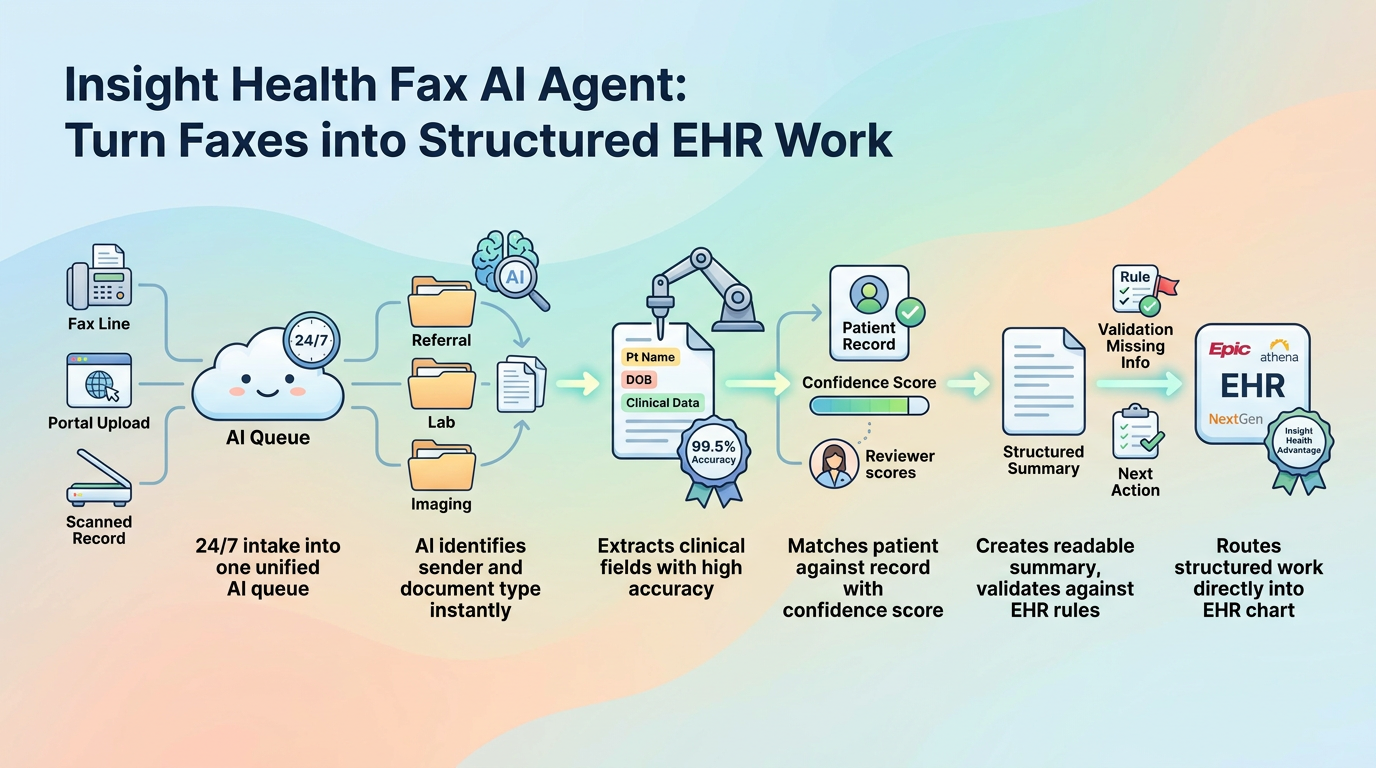
Your team should not spend the day sorting faxes by hand. That is the outcome we build for. Our Fax AI Agent turns inbound clinical faxes into structured, chart-ready work in your EHR.
Referrals stop waiting on the fax machine, and staff stop retyping records. That is what an AI fax service does. It reads every inbound document, matches the patient, and routes the result with zero keystrokes from staff.
The administrative math is hard to ignore. According to the CAQH 2024 Index, administrative work costs the US health system about $440 billion a year. CAQH counts fax among the manual workflows that a $20 billion shift to automation would replace.
We built the Fax AI Agent for the administrator who owns that cost. This guide explains what an AI fax service is and how it processes documents. It also shows how to evaluate one for a specialty group, MSO, or health system.
An AI fax service is software that reads inbound faxes, understands the clinical and administrative content, and routes structured data into the EHR. A traditional online fax service digitizes the transmission. An AI fax service acts on what the fax says.
We read every inbound fax, e-fax, portal upload, and scanned record into one queue. The system identifies the sender, classifies the document, extracts the data, matches the patient, and files the result.
We are direct about the limits. We do not file low-confidence matches on our own. Those hold for your staff, and setup asks your team to map fax lines and routing rules once.
Outcome first: a stapled 15 to 30 page packet becomes discrete, chart-ready documents in under two minutes. Nobody has to read the pile at 6 p.m.
Here is how a clinic automates inbound fax processing, step by step:
Capture. We pull every fax line and location into one unified inbound queue, 24/7, so nothing waits overnight.
Classify. We identify the sender and the document type, whether referral, lab result, imaging report, pathology, or authorization.
Extract. We pull the clinical and administrative fields at up to 99.5% accuracy on faxed documents.
Match. We match the patient against the record and attach a confidence score to the result.
Summarize. We produce a structured, readable summary of the packet.
Route. We file chart-ready work into the EHR and open the next action.
OCR converts the faxed image into machine-readable text. It is the starting point, not the finish line. Text alone does not tell you a referral is urgent or which provider it belongs to.
NLP reads the text the way a coordinator would. It recognizes that "pt" means patient, that a value is a creatinine result, and that a line names the referring physician.
We extract the fields that matter and validate them against the patient record. Every extracted field carries a confidence score. Low-confidence items hold for staff review rather than filing silently into the chart.
Faxes rarely arrive clean. One transmission staples a referral, labs, imaging, and pathology into a single 15 to 30 page bundle.
We deconstruct that bundle into discrete documents and file each to the right place. Generic OCR treats the whole packet as one record, which leaves the sorting to your staff.
Once the document is understood, we route it. A lab result goes to the ordering provider.
A referral opens a coordination task. A record with missing information triggers follow-up to the referring office.
The features below matter because they remove specific hours of manual work, not because they sound advanced.
One unified inbound queue across every fax line and location.
24/7 processing, so overnight faxes are handled before the front office opens.
Automatic deduplication of repeat and confirmation pages.
A clean work queue that shows staff only the exceptions.
We identify who sent the fax and what it contains before a person touches it. That lets us route a pathology report differently from an insurance form. It also lets us split multi-patient packets into individual charts.
We capture the clinical and administrative fields your staff would otherwise retype. Extraction runs at up to 99.5% accuracy on faxed documents. Patient matching uses name, date of birth, and demographics, and returns a confidence score.
We route each document to the correct chart, provider, and work queue. When a critical value or an urgent referral appears, we flag it. When a document is incomplete, we open a follow-up rather than filing a partial record.
Lead with the number your CFO cares about. In one 30-provider gastroenterology group, we reduced manual document review by 80% and moved four staff members to higher-value work.
That group saved $250,000 a year and cut cancellations by more than 16%. That is a named-scale customer outcome, not a projection.
Your coordinators stop opening, reading, and sorting every fax. Extraction runs at up to 99.5% accuracy, so staff review exceptions instead of retyping records. In the gastroenterology group above, that shift moved four people onto patient-facing work.
Documents route into the EHR in under two minutes, around the clock. A referral that used to sit in a fax queue for a week becomes a same-day scheduling task. That shortens time from referral received to appointment booked.
Manual re-entry introduces mistakes. A mistyped date of birth or medication name can cascade into a billing denial or a delayed appointment. Automated extraction with a confidence score removes most of that manual keying.
Every document, every location, and every open item lives in one queue with an audit trail. Administrators see the backlog, the exceptions, and what the AI did versus what a person changed. That visibility lets you staff to actual volume.
The fax is not the finish line. It is the entry point. Reading and filing the document is step one, and the value comes from what the document triggers next.
We treat fax intake as the front door to the whole workflow. A referral that lands on the fax line opens referral coordination. A record with gaps triggers missing-information follow-up to the referring office.
An incomplete history triggers a records backfill through health information exchange. Referrals, clinical documents, and fax stay the core story. Phone, intake, and prior authorization feed the same pipeline on one connected platform.
An AI fax service pays off where fax volume is high and referrals drive revenue. If you own the budget and the staffing plan across sites, the sections below map to your organization.
Specialty groups of 10 to 100+ providers live on inbound referrals, records, and authorizations. GI, orthopedics, pain and spine, cardiology, oncology, and neurosurgery all run on faxed documents. We support more than 60 specialties, so the routing logic matches how your service line works.
A multi-specialty group receives documents for many service lines through the same fax numbers. Without automated classification, staff hand-sort everything. We split and route by document type and specialty, so each chart gets the right record.
MSOs run shared services across many practices with no unified queue. That fragmentation is usually what forces a decision. We give you one inbound queue with location-based routing, an audit trail, and consistent handling across every site.
Health systems and their affiliated ambulatory networks need security review, integration depth, and multi-location routing before a pilot becomes a contract. We meet those requirements, route across locations, and integrate with the EHRs your network runs.
Integration depth decides whether structured data lands in the chart or in another inbox. We write chart-ready work directly into your system.
We support 11+ EHR integrations, including Epic, athenahealth, eClinicalWorks, NextGen, AdvancedMD, DrChrono, Elation, Charm Health, ModMed, and Office Practicum.
We match the patient and file the document to the correct chart and work queue.
We route lab results to the ordering provider and flag critical values.
We open follow-up tasks when a document is incomplete.
We keep an audit trail of what the AI did and what a person changed.
See the full list of EHR integrations for your system.
Inbound faxes carry protected health information, so security gates the deal. We say plainly what protects it.
HIPAA requires appropriate safeguards for protected health information and a signed Business Associate Agreement between you and any vendor that handles it. We are HIPAA compliant and sign a BAA on paid tiers.
SOC 2 Type II is an independent audit confirming that security controls operate over time, not just on paper. We maintain SOC 2 Type II, encrypted communications, and third-party penetration testing.
We encrypt data in transit and at rest. Every extracted field carries a confidence score, and low-confidence items hold for staff review rather than filing into the chart.
Production runs under our S.A.F.E. architecture, the Supervised Autonomous Framework for Evaluations, with real-time supervision and multi-model verification. Humans stay on the exceptions by design.
Read more about our trust and safety controls.
Traditional online fax, sometimes sold as integrated fax or eFax, digitizes the send and receive. It moves the paper into a digital inbox.
Your staff still sort, read, and retype every page. An AI fax service picks up where integrated fax stops.
Capability | Traditional online fax (integrated fax or eFax) | AI fax service |
|---|---|---|
Send and receive | Digitizes transmission | Digitizes, then reads and understands |
Document sorting | Manual, by staff | Automatic classification and packet splitting |
Data entry | Staff retype into the EHR | Automated extraction at up to 99.5% |
Patient matching | Manual look-up | Automated, with a confidence score |
Routing | Staff move each fax to a queue | Automated to the right chart and provider |
Missing information | Staff notice later, if at all | Flagged and followed up automatically |
Use these five criteria to evaluate any vendor, including us. Weigh them against your own fax volume and cost per document so you can build the business case.
Document understanding. Confirm the system understands clinical documents and splits multi-document packets, rather than reading text alone.
EHR integration depth. Ask which EHRs are live today and how structured data writes into the chart, not just an inbox.
Patient matching and exceptions. Ask the matching accuracy, whether it returns a confidence score, and what happens to records it cannot match.
Missing-information follow-up. Ask whether the tool chases missing data from referring offices or only files what arrives.
Security and audit. Confirm HIPAA, SOC 2 Type II, a BAA, an audit trail, and multi-location routing for your scale.
You can move from fax received to patient scheduled without adding headcount. Our Fax AI Agent captures every fax line, reads each document, matches the patient, and routes chart-ready work into your EHR in under two minutes. To see it on your own documents, book a demo.
A useful comparison starts with the workflow after a fax arrives. Insight Health reads clinical documents, matches the patient, routes structured data into the EHR, and connects fax intake to referral follow-up. The table below reflects how each company describes its product publicly, as of August 2026.
Vendor | What they sell | Document AI to EHR write-back | Referral and fax together | Exclusive EHR partnerships | HIPAA, SOC 2 Type II, and BAA |
|---|---|---|---|---|---|
Insight Health | Fax AI Agent for clinical document classification, extraction, patient matching, EHR routing, and referral follow-up. | Yes. Structured data routes into the EHR in under two minutes. | Yes. Fax intake connects to referral coordination and missing-information follow-up. | Office Practicum and Medicat, exclusive AI provider partnerships. | HIPAA compliant, SOC 2 Type II, with a BAA on paid tiers. |
Tennr | Patient orchestration for referral intake, coverage decisions, workflow automation, and follow-up. | Yes. Public materials describe data entry into EHRs and integration with eFax systems. | Yes. Public materials describe referral intake across phone, fax, and email. | Not disclosed as exclusive. | Not disclosed on the reviewed public product pages. |
HealOS | Healthcare automation agents for fax and referrals, documentation, benefits, prior authorization, front-desk calls, and billing. | Yes. Public pages describe reading, extracting, matching, and filing documents into the EHR. | Yes. Fax and referral management are presented as one agent workflow. | Not disclosed as exclusive. | HIPAA compliant, SOC 2 Type II, and a signed BAA are described. |
Documo | Cloud fax, Direct Secure Messaging, and intelligent document processing for healthcare. | Yes. Documents route to EHR, billing, or task queues, with named EHR integrations. | Yes. Public materials describe automated inbound referral and lab-result routing. | Not disclosed as exclusive. | HIPAA compliant, SOC 2 Type II, with a BAA included. |
PracticeEHR | AI-native EHR with AI Fax that reads, classifies, matches, and files inbound documents. | Yes, into PracticeEHR patient charts, with staff review of recommendations. | AI Fax handles referral document types. Broader referral coordination was not disclosed on the reviewed page. | Not disclosed as exclusive. | HIPAA compliant and SOC 2 attested. BAA terms were not disclosed on the reviewed page. |
What is fax-to-EHR automation?
Fax-to-EHR automation reads an inbound fax and identifies its document type and patient. It then extracts the required fields and routes structured information into the correct EHR chart or work queue. We complete that routing in under two minutes.
Can AI route lab results and referrals into the EHR?
Yes. We process referrals, labs and imaging, prior authorization requests, insurance documents, clinical notes, prescriptions, records requests, and claims. We route each to the right EHR destination.
Is an AI fax service HIPAA compliant?
It is when the vendor uses appropriate safeguards and signs a BAA for protected health information. We are HIPAA compliant and SOC 2 Type II, and we sign a BAA on paid tiers.
How is AI fax different from traditional eFax?
Traditional eFax digitizes sending and receiving. An AI fax service also understands the document. It classifies the document, extracts clinical data, matches the patient, and routes the result into the EHR.
Can one system handle inbound referral and fax intake?
Yes. We connect fax and document processing to referral coordination. After the document is routed, the workflow can identify missing information, contact the patient or referring office, and continue toward scheduling.
Is fax being phased out in healthcare?
No. Fax remains a primary way US hospitals exchange records. According to ONC/ASTP, about 75% of US hospitals still received summary-of-care records by mail or fax in 2023.
It persists because interoperability is incomplete. Per the ONC/ASTP data brief, only 43% of US hospitals were routinely interoperable across sending, receiving, finding, and integrating records in 2023. That gap keeps fax as the reliable fallback.
How is an AI fax service different from integrated fax or eFax?
Integrated fax and eFax digitize send and receive. They move paper into a digital inbox and stop there.
An AI fax service reads, classifies, extracts, matches, and routes each document into the EHR. Integrated fax delivers the page. An AI fax service acts on it.
What is the cheapest HIPAA-compliant fax service?
Basic HIPAA-compliant eFax is cheap per line, but it leaves your staff to sort documents and key data by hand. An AI fax service costs more per line and removes those staff hours instead. We would rather name that tradeoff than claim to be the cheapest, because the labor is where the real cost sits.
Can an AI fax service reduce prior authorization time?
Fax intake feeds prior authorization, so faster document handling shortens the front of that process. Each manual prior authorization by phone, fax, or email takes staff about 24 minutes, versus roughly 10 minutes done electronically, per the CAQH 2024 Index.
The AMA's 2025 prior authorization survey found practices handle about 40 prior authorizations per physician weekly, using roughly 13 hours of staff time. Capturing authorization documents as structured data at intake is the first step. It connects directly to our prior authorization workflow.
Fax intake is the front door. Once the document is structured, the work continues into scheduling and coordination.
Move from referral received to appointment booked with end-to-end referral management.
Read, extract, and route every clinical document with intelligent document processing.
Ready to clear the fax backlog? See the Fax AI Agent on your own documents and get a number you can take to your board.

