AI Front Desk: How Clinics Reduce Hold Times and Staff Burnout
This guide explains how AI phone assistants work in medical practices and how they help your front desk handle scheduling, prescription refills, and after-hours calls.



This guide explains how AI phone assistants work in medical practices and how they help your front desk handle scheduling, prescription refills, and after-hours calls without putting patients on hold. You will learn what to look for in a solution, how these systems connect to your EHR, and where AI fits into your existing workflows.
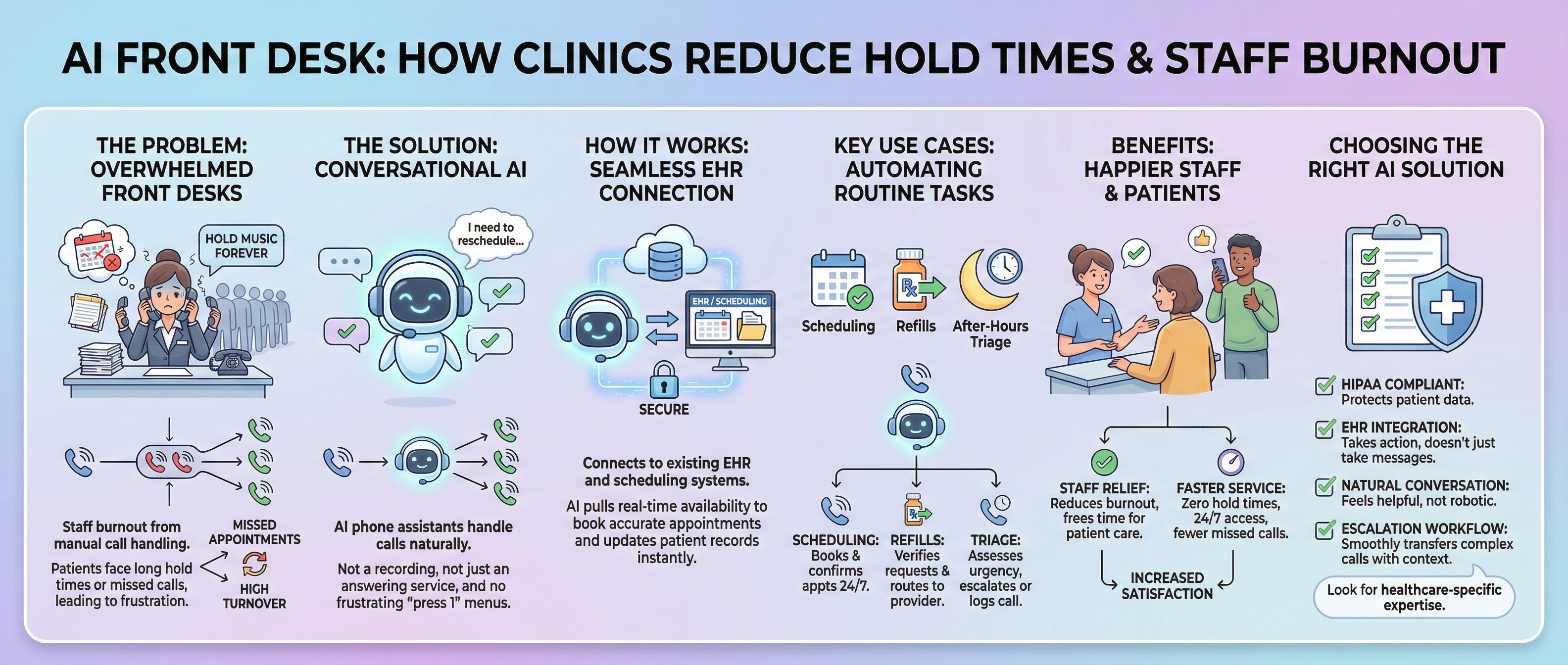
Most clinics rely on staff to manually answer every phone call. During busy periods, this creates a bottleneck where patients wait on hold or calls go unanswered entirely - medical practices miss 42% of incoming calls during business hours. After hours, the problem gets worse because there is simply no one available to pick up.
Front desk teams handle scheduling, prescription questions, billing inquiries, and urgent concerns all at once. This constant juggling leads to burnout, high turnover, and frustrated patients who cannot get through - front desk staff are most affected by turnover in medical practices. Every missed call represents a potential missed appointment or a patient who may switch to another practice.
The challenge is not a failure of staff effort. It is a volume problem that human teams cannot solve alone without significant hiring costs. Your front desk staff are doing their best, but there are only so many calls one person can answer at a time.
An AI front desk is software that answers, routes, and responds to phone calls using artificial intelligence. This means patients can call your clinic and have a real conversation with an AI phone assistant that understands what they need and takes action.
In healthcare, AI phone assistants handle tasks like scheduling appointments, answering common questions, processing prescription refill requests, and triaging urgent concerns. They do this without putting callers on hold or requiring staff intervention.
Unlike older phone trees where patients press buttons to navigate menus, modern AI phone assistants use natural language processing. A patient can say "I need to reschedule my Thursday appointment" and the AI understands the intent, checks availability, and confirms the new time. No button pressing, no "please hold," no callbacks.
Here is how AI phone assistants differ from what you may have used before:
AI phone assistants connect to your clinic's existing systems and take action based on patient requests. Once the initial setup is complete, the process runs automatically for every call.
The AI phone agent needs access to your existing systems to be useful. During onboarding, the platform connects to your EHR and scheduling software. This allows the AI to pull real-time availability so patients get accurate appointment options.
Changes made in your EHR appear instantly for the AI. If a provider blocks off time or a slot fills up, the AI knows immediately and will not double-book. You set up the integration once, and the AI stays in sync with your calendar from that point forward.
The AI listens and interprets what the patient needs without scripted responses. It recognizes common requests like scheduling, prescription refills, symptom questions, and billing inquiries. If the request is unclear, the AI asks clarifying questions just like a human would.
For example, a patient calling about a sore throat triggers basic triage questions. A patient wanting to reschedule prompts the AI to check availability in real time. A billing question routes to the appropriate department with context about what the patient asked.
The AI either resolves the request or hands off to a human when needed. For routine tasks, it books appointments, sends confirmation texts, answers FAQs, and logs call details automatically.
Complex or urgent calls transfer to a staff member with full context preserved. The receiving team member sees the complete call transcript and patient history, so the patient does not have to repeat themselves. This handoff happens seamlessly, and the patient feels like they are talking to one connected team.
AI phone assistants deliver the most value in high-volume, repetitive workflows. These are the scenarios where clinics see the biggest impact on their daily operations.
Scheduling is the highest-volume front desk task in most practices. The AI can book new appointments, handle rescheduling requests, and send reminders without any staff involvement.
The AI understands urgency, so acute cases are prioritized over routine follow-ups. Patients receive text confirmations with appointment details immediately after booking. This self-service capability works around the clock, reducing no-shows and freeing your staff for other tasks.
Prescription refills are routine but time-consuming when handled manually. The AI captures refill requests, verifies patient identity, and routes the request to the pharmacy or provider for approval.
The request is logged in the EHR for continuity. Your clinical team reviews and approves refills without having to answer the phone or take messages. This reduces phone volume significantly for practices with large patient panels.
Clinics need to manage urgent calls outside business hours without paying for a full answering service. The AI gathers symptoms, assesses urgency using clinical protocols, and routes to the on-call provider if needed.
This provides a much better patient experience than voicemail. Urgent cases reach the right person faster, and routine calls are logged for follow-up the next business day. Parents calling about a sick child at midnight get real guidance instead of a recording.
Pre-visit information gathering is often a bottleneck before appointments. The AI can ask intake questions, collect insurance information, and update the chart before the patient arrives.
This saves time during the actual visit. Your clinicians spend more time on care and less time on data entry. Patients appreciate not having to fill out the same forms repeatedly.
Clinics experience tangible outcomes after implementing an AI phone agent. The benefits extend beyond just answering more calls.
The AI answers every call, even during peak times or after hours. Calls are logged and routed appropriately, so patients do not need to try multiple times to get through.
More appointments get scheduled, and fewer patients switch to competitors out of frustration. For many practices, this alone recovers the cost of the AI phone assistant within the first month, especially considering missed calls cost practices $200,000 to $500,000 annually.
Front desk staff spend most of their time on repetitive answering and scheduling. The AI handles these routine calls, freeing your team for complex interactions and patient care support.
This reduces burnout and improves job satisfaction. Your staff can focus on the patients standing in front of them rather than constantly managing the phone queue. Many practices report that their front desk teams are happier and more engaged after implementing an AI phone assistant.
Patients expect quick, convenient service. The AI provides immediate responses without hold times, and patients can schedule or get information any time of day or night.
Text confirmations and reminders improve follow-through on appointments. Higher patient satisfaction leads to fewer missed appointments and better health outcomes overall.
The AI logs all calls and interactions, providing visibility into volume, timing, and common requests. This data informs staffing decisions and process improvements.
You can see exactly when your call volume peaks, what questions patients ask most often, and where your workflows might need adjustment. Practice managers can make data-driven decisions about resource allocation instead of guessing.
Not all AI phone agents are built the same. Clinics should evaluate key factors before choosing a solution. Here is what matters most:
Ask vendors what types of calls the AI cannot handle. Understanding limitations helps you plan for appropriate escalation. A good vendor will be transparent about where human staff are still needed.
The best AI phone assistants are built by people who understand clinical workflows. At Insight Health, our platform was developed by practicing physicians who know what it is like to run a busy practice. This specialty awareness makes a real difference in how well the AI handles your patients.
AI phone agents are becoming standard infrastructure for modern clinics. As the technology improves, these systems will handle more complex conversations and integrate more deeply with clinical workflows.
Here is what you can expect in the near term:
The goal is staff augmentation, not replacement. AI handles volume so your clinicians can focus on complex cases and relationship-building. For practices struggling with staffing shortages and rising call volumes, AI phone assistants offer a way to do more without hiring more.
The AI recognizes urgent keywords and symptoms, then immediately transfers the call to an on-call provider or nurse with full context preserved. All call details are logged in the EHR so the provider has complete information before speaking with the patient.
Most modern AI phone agents integrate with major EHR platforms during onboarding, pulling real-time scheduling and patient data. Insight Health integrates with Epic, AdvancedMD, Office Practicum, and other common systems used by medical practices.
Reputable healthcare-focused AI phone agents are built with HIPAA compliance as a core requirement, including end-to-end encryption and audit logs. Always verify compliance certifications before implementation, and ask about SOC 2 compliance as well.
Complex clinical questions, insurance authorization issues, and highly emotional or distressed patients typically require human staff. The AI recognizes these situations and escalates seamlessly with full context so your team can take over.
Most solutions go live within days to weeks, depending on your EHR integration and customization needs. Initial setup usually takes a few hours, and ongoing refinement happens based on call patterns and feedback from your team.
I encourage you to explore how an AI phone agent can fit into your clinic's workflow. Start by evaluating a few solutions against the criteria above, test a demo call, and ask vendors about their healthcare expertise and compliance certifications.
The goal is to find a partner that understands your practice and can support your growth. Look for a platform built by people who have actually worked in clinical settings and understand the pressures your front desk faces every day.
Insight Health builds AI phone assistants developed by practicing physicians and purpose-built for clinical workflows. Our platform handles scheduling, intake, triage, and follow-ups so your front desk team is not overwhelmed and your patients are not stuck on hold. Everything we build meets strict HIPAA and SOC standards because trust is non-negotiable in healthcare.

AI-Enhanced Healthcare with Insight Health
