How Clinics Are Reducing Staff Burnout With AI Assistants
Clinic staff burnout is driving turnover and hurting patient care, and phone management is one of the biggest contributors.


Clinic staff burnout is driving turnover and hurting patient care, and phone management is one of the biggest contributors. This article breaks down why phone calls create so much administrative burden and how AI phone assistants can help your team reclaim time for meaningful work.
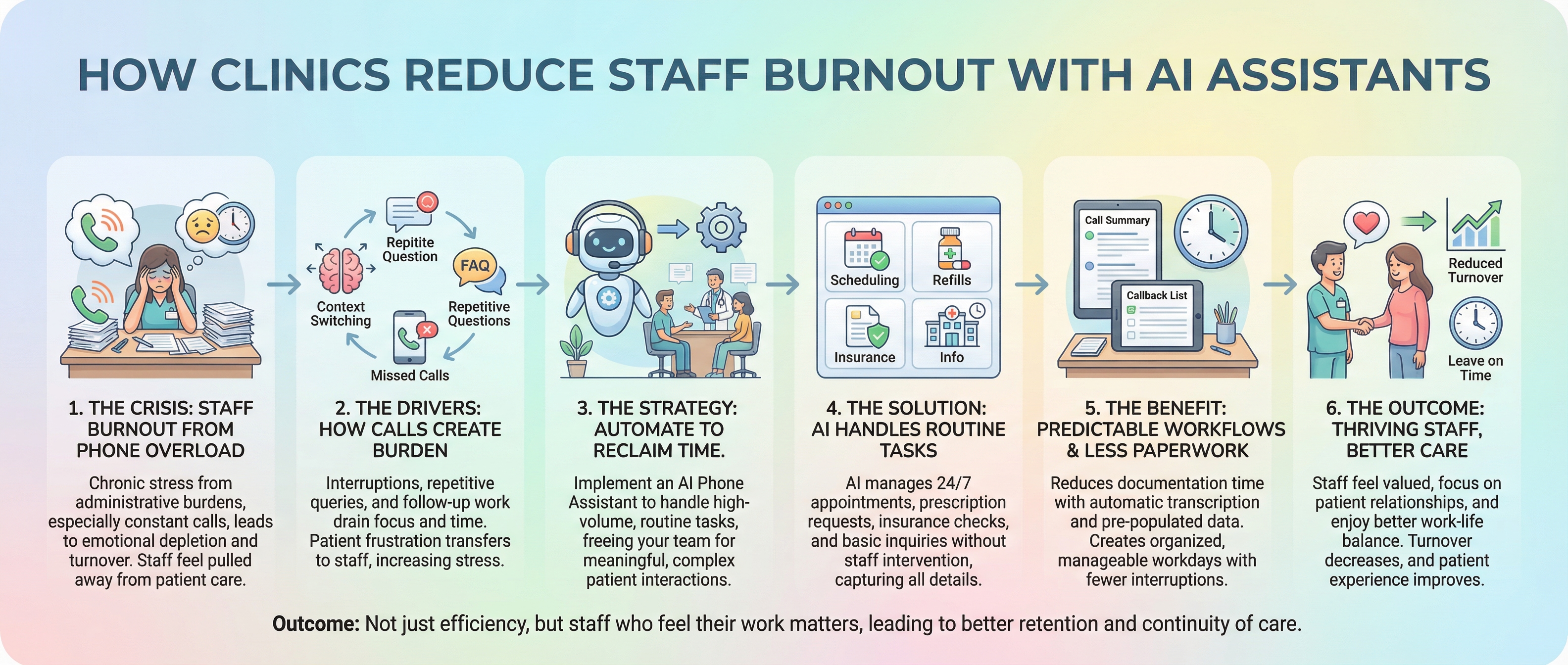
Staff burnout is a state of chronic exhaustion caused by unmanaged workplace stress. It shows up as emotional depletion, cynicism about work, and feeling unable to perform at your best. This is not a personal weakness. It is a systemic problem created by how clinics operate.
The root causes are consistent across most practices. Staff face excessive administrative tasks that pull them away from patient care. Staffing shortages, cited by 65% of nurses as a top burnout factor, force remaining team members to absorb extra work. Limited control over schedules and workflows creates a sense of helplessness. Rare feedback and appreciation leave staff feeling invisible.
When your team cannot deliver the care they entered medicine to provide, moral distress follows. This disconnect between their values and daily reality becomes the tipping point for departure. Many staff members report they are likely to switch jobs within the next year, and a significant portion say they would leave healthcare altogether.
The consequences extend beyond individual suffering. Burned-out staff make more errors, provide lower quality care, and create a negative experience for patients. High turnover forces clinics to constantly recruit and train new employees, with replacement costs reaching $400,000 to $500,000 for a single physician. The cycle feeds itself as remaining staff absorb even more work.
Phone management is one of the most overlooked drivers of clinic staff burnout. Every unanswered call represents a failure point in the patient experience and a source of staff frustration. The constant ringing creates background stress that compounds throughout the day.
Front desk staff juggle multiple concurrent calls while also handling patient check-ins, insurance verification, and scheduling. Clinical staff interrupt patient care to handle callbacks and answer questions that could have been resolved earlier. After-hours calls create on-call fatigue and erode work-life boundaries.
The phone burden breaks down into several specific problems:
The administrative burden is not just time lost. It is the constant interruptions, the feeling of never catching up, and the guilt of putting callers on hold. Staff who entered healthcare to help patients find themselves spending hours managing phone logistics instead.
Think about what happens when your front desk is understaffed. The phone rings while a patient stands at the window. Your staff member tries to help both, does neither well, and feels terrible about it. This scenario repeats dozens of times per day in busy clinics.
The emotional toll is significant. Staff feel they are failing patients even when they are working as hard as they can. They go home exhausted not from meaningful work but from managing chaos. Over time, this erodes their connection to why they chose healthcare in the first place.
Effective burnout interventions address root causes, not just symptoms. Telling staff to practice self-care while maintaining impossible workloads does not work. You need to change the systems that create the pressure.
The most impactful strategies target the specific tasks that drain staff energy. Phone management is one of the largest opportunities because it affects every role in the clinic and creates cascading problems throughout the day.
Routine calls follow predictable patterns that do not require human judgment. An AI phone assistant handles these without staff intervention, freeing your team to focus on complex patient interactions that actually need their expertise.
Consider what your staff currently handles on the phone. Most calls fall into a few categories: appointment scheduling, prescription refill requests, insurance questions, and basic clinic information. These are important tasks, but they do not require clinical training or human creativity.
An AI phone assistant can manage these high-volume tasks:
When staff no longer field routine calls, they redirect energy toward meaningful work. The phone stops feeling like an interruption and becomes a support system. Your front desk can focus on patients in the office rather than constantly answering the phone.
The key is that the AI phone assistant must understand clinical workflows. A system built by physicians knows the difference between a routine refill request and a symptom that needs clinical attention. It knows when to handle something automatically and when to escalate to your team.
Clinical staff spend substantial time on call documentation, insurance follow-ups, and administrative callbacks. Every phone interaction generates paperwork. Multiply that by dozens of calls per day and you understand why staff feel buried.
An AI phone assistant captures caller information automatically, eliminating manual note-taking and reducing follow-up work. Call summaries are transcribed and organized without staff effort. Insurance information is captured during the initial call, not researched later. Callback lists are pre-populated with full context instead of reconstructed from voicemail.
Reducing documentation burden directly improves job satisfaction. Staff feel less behind and more in control of their workday. The time saved on paperwork can be redirected to patient care or simply to leaving work on time.
This matters for preventing burnout in healthcare because documentation is one of the most frustrating parts of the job. Staff did not enter medicine to fill out forms. When you reduce that burden, you reconnect them with the work they actually want to do.
Burnout intensifies when staff cannot predict their day. Constant interruptions from phone calls and administrative crises create a sense of chaos. You cannot plan your time when you do not know what will happen next.
Predictable workflows allow staff to complete tasks without constant disruption. They can focus on one thing at a time instead of constantly switching between competing demands. This reduces mental fatigue and increases the quality of their work.
AI phone assistants create predictability in several ways. Calls are handled consistently rather than scattered throughout the day. Staff receive pre-organized callback lists rather than reactive call management. Appointment slots are filled proactively, reducing last-minute scheduling chaos. After-hours calls are managed without waking clinical staff for routine requests.
When staff know what to expect, they regain a sense of agency. The workday becomes manageable rather than overwhelming. This predictability is one of the most underrated factors in preventing burnout.
Think about the difference between starting your day with a clear plan versus starting with a pile of voicemails and a ringing phone. The first scenario feels manageable. The second feels like you are already behind before you begin.
An AI phone assistant built by physicians understands clinic workflows and clinical priorities. It handles the phone burden without replacing the human judgment that patient care requires. The goal is not to remove staff from patient interactions but to remove the repetitive tasks that drain their energy.
The changes are measurable when clinics deploy an AI phone assistant. Staff stop answering routine calls and start handling complex patient needs that require their training. Front desk staff transition from call management to relationship-building with patients in the office. Clinical staff reclaim time for patient care instead of phone callbacks and documentation.
After-hours calls no longer interrupt clinician sleep or family time for routine requests. The AI handles scheduling and refill requests at 2 AM so your team can rest. When something truly urgent comes through, it escalates appropriately.
Most importantly, staff feel valued because their expertise is applied to meaningful work. They are no longer answering the same questions hundreds of times per week. They are solving problems, building relationships, and providing care that makes a difference.
The outcome is not just efficiency. It is staff who feel their work matters, who leave the office without guilt, and who see a future in healthcare. How do burnout prevention systems lower healthcare costs for employers? Reduced turnover is the primary mechanism. Replacing staff costs healthcare systems $9 billion annually for nurses alone and is disruptive. When your team stays longer, you avoid those costs while maintaining continuity of care.
Insight Health builds AI phone assistants specifically for clinical workflows. Our platform handles scheduling, intake, triage, and follow-ups so front desk teams are not overwhelmed and patients are not stuck on hold. Everything we build is developed by practicing physicians and meets strict HIPAA and SOC standards.
Most clinics report noticeable changes within the first two to four weeks as staff adjust to fewer phone interruptions and more predictable workflows.
AI phone assistants are designed to handle routine requests and recognize when to escalate complex or urgent matters to clinical staff for human judgment.
Quality AI phone assistants include seamless escalation paths so patients can always reach a staff member when needed or preferred.

AI-Enhanced Healthcare with Insight Health
