Healthcare AI fax service: why practices are switching to AI fax automation
We explain how a healthcare AI fax service works and how it can save your practice hours of manual document processing each day.



Our Fax AI Agent reads inbound clinical faxes, identifies the patient and document type, extracts the needed data, and routes structured information into the right EHR queue in under two minutes. For a practice handling referrals, labs, prior authorization, insurance, and records requests, that turns a shared fax inbox into work your team can act on.
A healthcare AI fax service is software that automatically reads, sorts, and files incoming faxes into patient records without routine manual data entry. This means your staff no longer spends hours each day opening faxes, figuring out which patient they belong to, and typing information into your EHR.
For most practices, fax remains the primary way documents move between providers, labs, insurance companies, and specialists. According to Altera Digital Health (2025), approximately 70% of healthcare providers continue to use fax machines to exchange medical information.
The MGMA 2026 Phone and Fax Solutions Survey found 64% of practice leaders report fax platforms not integrated with the EHR or practice management workflow. In the same survey, 40% describe fax communication as inefficient. Our MGMA phone and fax workload report breaks the results down by specialty.
The problem is that processing these faxes manually consumes staff time on every page. Each one requires someone to read it, search for the right patient chart, and enter the relevant information by hand.
Healthcare AI fax services handle this work automatically. The AI reads the document, identifies the patient, pulls out key information, and delivers everything to the correct chart. Your staff review exceptions instead of keying in every fax, and we route each document in under two minutes.
Our AI Phone Agent feeds the same pipeline from the calls side, so a referral is handled the same way whether it arrives by fax or by phone.
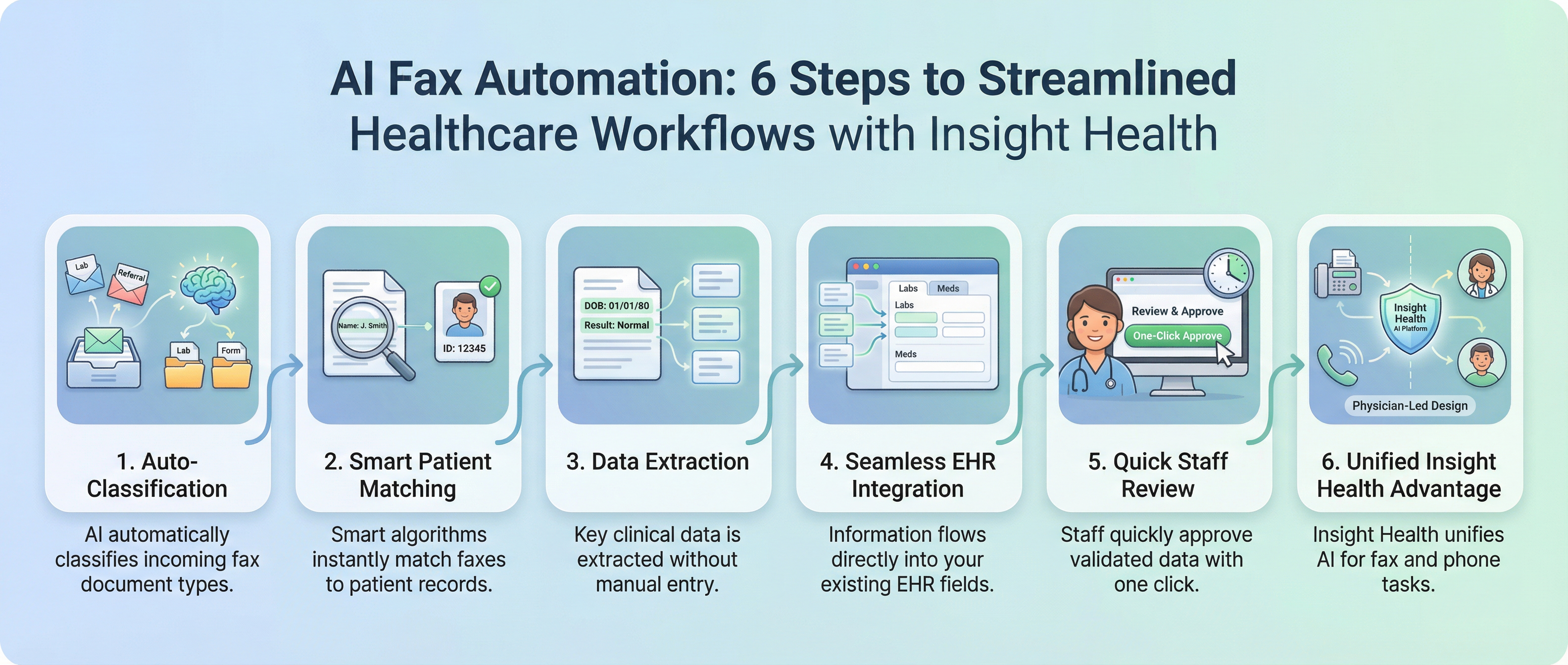
AI fax automation follows a specific sequence of steps that removes routine manual touchpoints from your workflow. Understanding each step helps you see exactly where the time savings come from.
When a fax arrives, the system captures and digitizes it automatically. The AI then reads the document and determines what type it is.
A lab result looks different from a referral, which looks different from an insurance authorization. The system learns to recognize these patterns.
Next, the AI locates the correct patient record. It uses information from the document like the patient's name, date of birth, or medical record number to find the matching chart in your EHR. If the system is uncertain about a match, it flags the fax for human review rather than making an incorrect assignment.
The AI then extracts key information from the document. This includes test values, medication names, dates, and other relevant data.
Finally, the extracted data and the original document are delivered directly into your EHR. Your staff reviews the AI's work and approves it with a single click.
The routine work happens in the background. Your staff handle the exceptions. In one 30-provider gastroenterology group, administrators reduced manual document review by 80%, moved four staff members to higher-value work, and saved $250,000 a year.
Modern healthcare AI fax services include several features that work together to reduce administrative burden. Each feature addresses a specific pain point in traditional fax processing.
Document classification means the AI automatically identifies what type of fax arrived. Your staff no longer needs to sort through mixed batches of faxes to figure out what each one is.
We classify every inbound document type your fax line receives, including:
We also split multi-document fax packets into separate items, so a 20-page referral bundle with labs and imaging is filed as discrete documents. This classification happens instantly as faxes arrive. The system routes each document appropriately based on your practice's preferences and workflows.
Digital fax, OCR, and AI document processing all start with the same faxed page. They differ in how much work they leave for your staff.
| Approach | What it does | What your staff still do |
|---|---|---|
| Digital fax | Delivers the fax image to an inbox. | Sort each document and key the data into the EHR. |
| OCR | Turns the page into searchable text. | Work out the document type, patient, and urgency, because OCR does not know them. |
| AI document processing | Classifies the document, extracts fields, matches the patient with a confidence score, and routes it to the work queue. | Review the low-confidence items held for staff review. |
Generic scanning turns a fax into searchable text. We turn it into structured, patient-matched, chart-ready work. Humans stay on the exceptions by design.
Patient matching is a slow part of manual fax processing. Finding the right chart for each document is slow, manual work.
The AI handles this automatically. It reads identifying information from the fax and locates the corresponding patient record. The system uses multiple data points to confirm the match, including name, date of birth, and medical record number when available.
When the AI is confident about a match, it assigns the document automatically. When it is uncertain, it presents options for your staff to choose from. This approach maintains accuracy while cutting manual document review by up to 80%.
Data extraction means the AI pulls specific information from documents and formats it for your EHR. Key fields like test results, medication names, and dates are captured automatically.
This removes routine data entry. Your team reviews what the AI flags and approves the rest with a click. There is no copying and pasting between systems and no double entry.
According to the 2025 CAQH Index, US healthcare still has a remaining $21 billion savings opportunity through full automation of manual and partially manual transactions.
The extracted data flows directly into the fields where your clinicians need it. A lab result appears in the lab section of the patient's chart. A medication list appears in the medication section. Everything lands where it belongs.
The benefits of AI fax automation extend beyond simple time savings. Practices see improvements across multiple areas of their operations when they automate routine fax processing.
Your staff no longer key routine fax data into patient records. We read, structure, and route each document in under two minutes, and front offices see 80% less manual document review. That time goes back to referral follow-up and patient-facing work.
Faxes reach the right patient chart immediately instead of sitting in an inbox waiting for someone to process them. This speed matters most for urgent documents.
When documents flow into patient records automatically, your entire care team operates with current information.
Repetitive fax processing is one of the biggest sources of administrative frustration in practices.
Removing this task lets your team focus on patient interaction and meaningful work.
According to the AMA, 43.2% of physicians reported at least one symptom of burnout in 2024.
When documents reach patient records faster, your clinicians can act on them faster. This means quicker callbacks to patients and faster care coordination with other providers.
Patients notice when their care team responds promptly. A parent waiting for their child's lab results appreciates a same-day callback.
A patient with a new referral appreciates getting scheduled quickly. These interactions build trust and loyalty.
Healthcare AI fax services handle a wide range of document types that practices receive daily. The technology works best for high-volume, repetitive documents that follow predictable formats.
Lab result routing is a high-volume use case. Incoming lab reports are automatically matched to patients and placed in their chart for clinician review. This removes the manual work of sorting through stacks of results and filing each one individually.
Referral processing moves new patients toward scheduling faster for practices that receive many new patient referrals. In the MGMA 2026 survey, referrals ranked among the top three fax reasons for 73% of practices, and for 84% of gastroenterology groups.
The AI identifies new referrals, creates patient charts when needed, and notifies scheduling staff automatically. This reduces the time from referral receipt to patient contact, which helps capture more new patients.
Insurance authorization management keeps approved procedures moving forward. Authorization forms are classified, key approval codes are extracted, and documents are tracked for follow-up. Your billing team always knows the current status of pending authorizations.
Patient intake forms from new patients are matched to their record and key information is pre-populated in your system. This reduces the data entry burden when patients arrive for their first appointment.
Specialist reports from consultations are routed to the correct patient and flagged for clinician review. Your primary care providers see specialist recommendations without hunting through fax inboxes.
Healthcare AI fax services integrate directly with your existing EHR system through APIs. API stands for application programming interface, which is the technology that allows different software systems to communicate with each other.
This integration means faxes and extracted data flow directly into the platform your team already uses daily. There is no separate login, no separate inbox, and no manual transfer between systems. Your staff accesses fax documents the same way they access other patient records.
Common integrations include Epic, AdvancedMD, Office Practicum, and other cloud-based platforms. The best solutions are built specifically for healthcare workflows and understand how clinical teams actually use their EHR systems.
Our implementation team typically handles the integration during setup. Most groups go live in 2 to 4 weeks, starting with one fax line. Your existing workflows continue with minimal disruption while the new automation runs in the background.
Healthcare AI fax services must meet strict regulatory requirements because they handle protected health information (PHI). PHI includes any information that could identify a patient, such as names, dates of birth, medical record numbers, and clinical data. According to HHS, the HIPAA Rules generally require covered entities to sign a business associate agreement (BAA) with business associates, such as a fax vendor, so those vendors appropriately safeguard protected health information.
Any service you consider should demonstrate compliance with these standards:
| Security requirement | What it means |
|---|---|
| Encryption in transit | All faxes are encrypted as they travel between providers and your system. |
| Encryption at rest | Stored faxes are encrypted on secure servers. |
| Access controls | Only authorized staff can view patient information. |
| Audit trails | Every access to a patient record is logged and traceable for compliance audits. |
| SOC 2 Type II certification | Security controls have been independently audited and verified. |
In the MGMA 2026 survey, 93% of practice leaders placed HIPAA security and controls among their top four evaluation criteria. Ask every vendor for a signed BAA and a current SOC 2 Type II report before signing. A vendor that cannot produce this documentation is not ready for healthcare use.
For more detail, see our HIPAA-compliant AI fax buyer's guide.
We are a physician-founded team, so we design for the compliance requirements that clinical teams face daily. We build these requirements in from the beginning rather than adding security features as an afterthought.
When evaluating AI fax services, focus on criteria that directly impact your daily operations. Not all solutions are built specifically for healthcare workflows, and generic document processing tools often fall short in clinical settings.
| Consideration | Why it matters |
|---|---|
| Accuracy rate | Ask for field-level accuracy. We report 99.5%, which keeps staff review to the exceptions. |
| EHR compatibility | The system must integrate with your specific EHR platform, not require a separate workflow. |
| Implementation timeline | Faster setup means your team starts saving time sooner. |
| Customer support | Healthcare practices need responsive support when issues arise with critical workflows. |
| Pricing model | Understand whether you pay per fax, per user, or flat monthly fee based on your volume. |
| Mobile access | Your team should access faxes from the office or remotely with the same security. |
Ask potential vendors about their experience with practices similar to yours. A solution built for a single hospital department may not fit a 40-provider specialty group or an MSO routing faxes across a dozen sites. Ask for references at your size, specialty, and EHR.
Fax automation works best as the front of a broader document workflow. When the same platform also handles referral coordination and prior auth, a document becomes a booked visit instead of another task.
Going further: Once your fax workflow is automated, see how it fits into a broader strategy in our companion piece on building an AI-first medical practice.
Use these questions to compare vendors. Our answers are below.
| Question to ask | Our answer |
|---|---|
| What does the product do? | Fax AI Agent for clinical document classification, extraction, patient matching, EHR routing, and referral follow-up. |
| Does document AI write back to the EHR? | Yes. Structured data routes into the EHR in under two minutes. |
| Do referral and fax intake run together? | Yes. Fax intake connects to referral coordination and missing-information follow-up. |
| Do you have exclusive EHR partnerships? | Office Practicum and Medicat, exclusive AI provider partnerships. |
| Are you HIPAA compliant and SOC 2 Type II, with a BAA? | HIPAA compliant, SOC 2 Type II, with a BAA on paid tiers. |
We support standard healthcare interoperability through FHIR R4 and HL7v2. Two exclusive AI provider partnerships extend that coverage with advanced integration not available to external AI vendors.
| Integration type | EHRs and partners |
|---|---|
| Standard FHIR R4 and HL7v2 integrations | athenaOne, Epic, eClinicalWorks, NextGen, AdvancedMD, DrChrono, Elation, Charm Health, ModMed, iKnowMed, and Office Ally. |
| Exclusive AI provider partnerships | Office Practicum and Medicat, with advanced integration not available to external AI vendors. |
Most groups go live in 2 to 4 weeks.
Fax-to-EHR automation reads an inbound fax, identifies its document type and patient, extracts the required fields, and routes structured information into the correct EHR chart or work queue. Our Fax AI Agent completes that routing in under two minutes.
Yes. We process referrals, labs and imaging, prior authorization requests, insurance documents, clinical notes, prescriptions, records requests, EOBs, and claims, then route each document to the appropriate EHR destination.
The vendor must use appropriate safeguards and execute a BAA when it handles protected health information. We are HIPAA compliant and SOC 2 Type II, and offer a BAA on paid tiers.
Traditional eFax digitizes sending and receiving. AI fax also understands the document, classifies it, extracts clinical data, matches the patient, and routes the result into the EHR, reducing the manual work after delivery.
Yes. We connect fax and document processing to referral coordination. After the document is routed, the referral workflow can identify missing information, contact the patient or referring office, and continue toward scheduling.
We extract fields from faxed clinical documents at 99.5% field-level accuracy, including handwritten and messy pages. Every field carries a confidence score, and you set the threshold for auto-approval. Anything below it goes to staff review.
Yes. We connect to the fax infrastructure you already run, including fax forwarding, RightFax, network folders, and SFTP feeds, so referring offices keep sending to the numbers they use today. Most groups start with one fax line and add the rest once they trust the output.
It goes to a person. Low-confidence documents and unmatched patients land in a review queue instead of being filed, and the audit trail shows what the AI did and what your staff changed.
Most groups go live in 2 to 4 weeks, starting with one fax line. Our implementation team handles the EHR connection, and you see hours reclaimed and backlog cleared within the first month.
Read our fax-to-EHR automation guide to see how clinical documents route into the chart, and see how AI turns referrals into booked appointments. MagicDocs, our AI referral coordinator, extends intelligent document processing to broader healthcare paperwork.
Explore our Fax AI Agent or book a demo to review your document mix, routing rules, and referral follow-up workflow.

AI-Enhanced Healthcare with Insight Health
