AI prior authorization software for specialty clinics in 2026
AI prior authorization software for specialty clinics: procedure PA vs pharmacy ePA, CMS-0057-F, FHIR PAS, and a named vendor matrix including Insight Health.


Most "AI prior authorization" roundups mix payer utilization-management tools, pharmacy ePA networks, and clinic software as if they do the same job. They do not. I wrote this guide for specialty clinics that need procedure prior authorization (pain ESI, imaging, surgery) to leave the chart with complete clinical evidence, then reach the payer electronically. That is the work Insight Health is built for.
If you are comparing CoverMyMeds, Develop Health, Cohere, Availity, or a generic EHR scrape tool, start with that distinction. Pharmacy ePA is not procedure PA. Payer UM is not a provider workflow. CMS-0057-F (the January 2027 electronic prior authorization mandate) is a FHIR PAS deadline for covered payers, not a reason to buy a portal that still makes your staff hunt for notes.
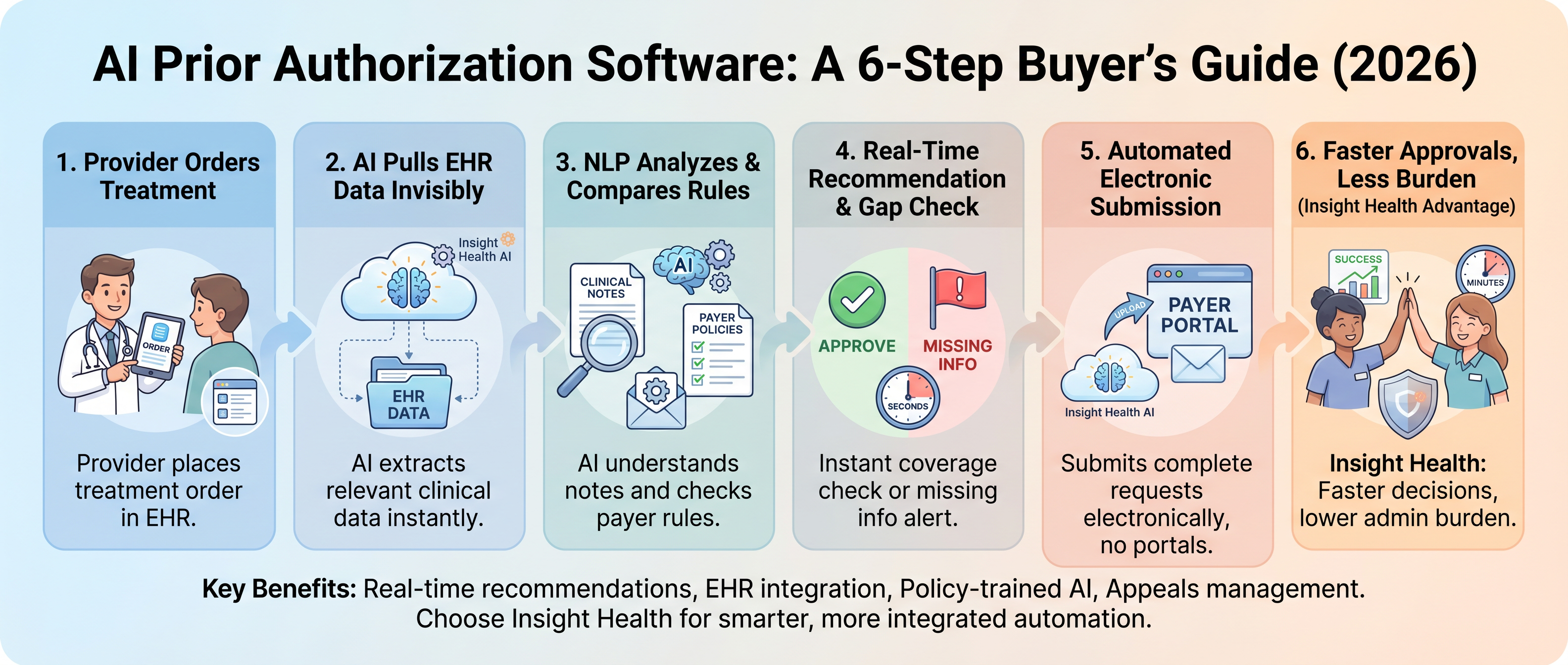
AI prior authorization software automates the approval request providers must complete before delivering certain treatments. Staff should not be copying notes into payer portals, sitting on hold, or guessing which guideline the plan will apply.
There are two capture models, and they are not equal:
The rest of the loop is the same in theory: match the order to a payer policy, check completeness, submit electronically, and track determination. The difference is whether you built a complete packet or you automated a denial.
CMS-0057-F is the CMS Interoperability and Prior Authorization final rule. Covered payers (Medicare Advantage, Medicaid managed care, CHIP, and QHP issuers on the Federally Facilitated Exchange) must support electronic prior authorization using FHIR Prior Authorization Support by January 1, 2027. Urgent requests have a 72-hour clock. Standard requests have 7 days. Fee-for-service Medicare and most employer plans are outside that mandate.
What this means for a specialty clinic:
When you compare options, ignore feature lists that could describe any generic automation tool. Ask whether the product reduces time-to-submit and first-pass approvals on the procedures you actually bill.
Use this matrix as a filter, not a scorecard. Public positioning only. I am not quoting competitor prices I cannot verify.
| Vendor | Built for | PA type | CMS-0057-F / FHIR PAS | How clinics usually buy it |
|---|---|---|---|---|
| Insight Health | Specialty clinics (procedure PA) | Medical / procedure | Provider-side packet plus electronic submit; PAS-ready workflow | Direct, with EHR integration |
| Cohere Health | Health plans (utilization management) | Payer UM | Payer-side; claims 85% real-time approvals and about 25M covered lives | Through the plan, not as clinic software |
| Availity AuthAI | Health plans and payer connectivity | Payer portal / AuthAI | Positions as CMS-0057 ready; providers usually access via plans | Through participating payers |
| Develop Health | Prescription / medication PA | Pharmacy ePA | Medication workflow, not procedure PA | Direct, for drug authorizations |
| CoverMyMeds | Providers and pharmacies | Pharmacy ePA (medical expanding) | Pharmacy network first; free for providers | Free ePA network |
| Myndshft (DrFirst) | Unified medical + pharmacy | Medical and pharmacy | Enterprise connectivity; confirm PAS with sales | Enterprise contract |
I co-founded Insight Health with physicians who still live in this workflow. Our prior authorization product is procedure PA for specialty clinics. It captures medical necessity during the visit instead of scraping an incomplete chart later, then assembles a complete packet and submits when readiness is at 95% or higher.
That is why pain ESI that used to take about 45 minutes of coordinator time can drop under 5. We aim for 90%+ first-pass approvals against a 70 to 80% industry baseline. HIPAA, SOC 2 Type II, and a BAA on paid tiers are table stakes. We integrate with athenaOne, Epic, eClinicalWorks, NextGen, AdvancedMD, DrChrono, Elation, Charm Health, ModMed, Veradigm, and CGM Aprima, plus exclusive advanced integrations with Office Practicum and Medicat. FHIR R4 and HL7v2 are in the stack. If your clinic also drowns in referral faxes, the same platform covers AI fax and the referral coordinator loop. Those spokes share one intelligent document processing hub.
Cohere is payer utilization management. Public materials describe AI-assisted review, a claimed 85% real-time approval rate, and coverage on the order of 25 million lives. That is a health-plan product. If you are a clinic, you meet Cohere as the plan's UM vendor, not as software you buy to run your front office.
Availity is the multi-payer connectivity layer most clinics already know. AuthAI is positioned for fast, auditable recommendations and CMS-0057 readiness. Providers usually reach it through a health plan relationship, not as a standalone clinic app that writes your note.
Develop Health is prescription and medication prior authorization. That is a real category, and it is the wrong category for ESI, MRI, or surgical PA. If a listicle ranks Develop Health as "best AI prior authorization software" without saying "pharmacy," treat that as a category error, not a product review.
CoverMyMeds is free for providers and pharmacies and sits on a very large pharmacy network (publicly cited as 900,000+ providers and 50,000 pharmacies). Pharmacy ePA is the core. Medical PA is newer. Use it for drugs. Do not use it as your ESI strategy.
Myndshft markets unified medical and pharmacy prior authorization, rules across a large payer set, and a claimed drop from roughly 50 minutes of manual work to under 5. DrFirst acquired it in 2024 and cites a large EHR network. Confirm FHIR PAS and specialty procedure coverage on a demo. Do not assume pharmacy strength equals ESI strength.
Start with the authorization you actually send:
Then verify three things on every demo: your EHR is on the integration list, FHIR PAS is a real submit path (not a slide), and the vendor will sign a BAA. HIPAA and SOC 2 Type II are the floor.
Implementation should start from your current clinical workflow, not from a portal login. Map one high-volume procedure (pain ESI is a clean example), measure minutes per request and first-pass rate, then expand. If documentation is fragmented across phones, faxes, and intake, fix capture first. Procedure PA still starts as a document problem. Intelligent document processing on MagicDocs is the hub that connects the fax packet, the referral, and the authorization. That is the same reason we built ambient documentation next to PA rather than treating them as unrelated products.
Contact us if you want that walkthrough on your specialty and EHR.
Prior authorization is the specific step where a provider must get payer approval before delivering certain treatments. Utilization management is the broader payer function that also includes concurrent review during treatment and retrospective review after treatment. Cohere is a UM suite. Insight Health is clinic-side procedure PA.
The mandate sits on covered payers, not on every clinic. You still need a way to assemble a complete packet and submit electronically (FHIR PAS) if you want to use that rail. Fee-for-service Medicare and most employer plans are outside the mandate. Details: CMS-0057-F prior authorization rule.
No. CoverMyMeds and Develop Health are medication workflows. Procedure PA for injections, imaging, and surgery needs visit-level clinical evidence. Mixing them in one "best software" list is how clinics buy the wrong tool.
No. Insight Health integrates with major EHRs (athenaOne, Epic, eClinicalWorks, NextGen, AdvancedMD, DrChrono, Elation, Charm Health, ModMed, Veradigm, and CGM Aprima) and has exclusive advanced integrations with Office Practicum and Medicat. Confirm your EHR on any other vendor's list before you sign.
Do not buy a system that auto-denies in a black box. Insight Health scores readiness and submits when the packet is complete; clinicians stay in the loop. Payer-side engines like Availity AuthAI are typically recommendation layers with a human or plan reviewer still accountable. Auditability is required for patient safety and compliance.

AI-Enhanced Healthcare with Insight Health
