How AI Turns Clinical Referrals Into Booked Appointments
How AI Processes Incoming Clinical Referrals (Including Faxed Referrals)


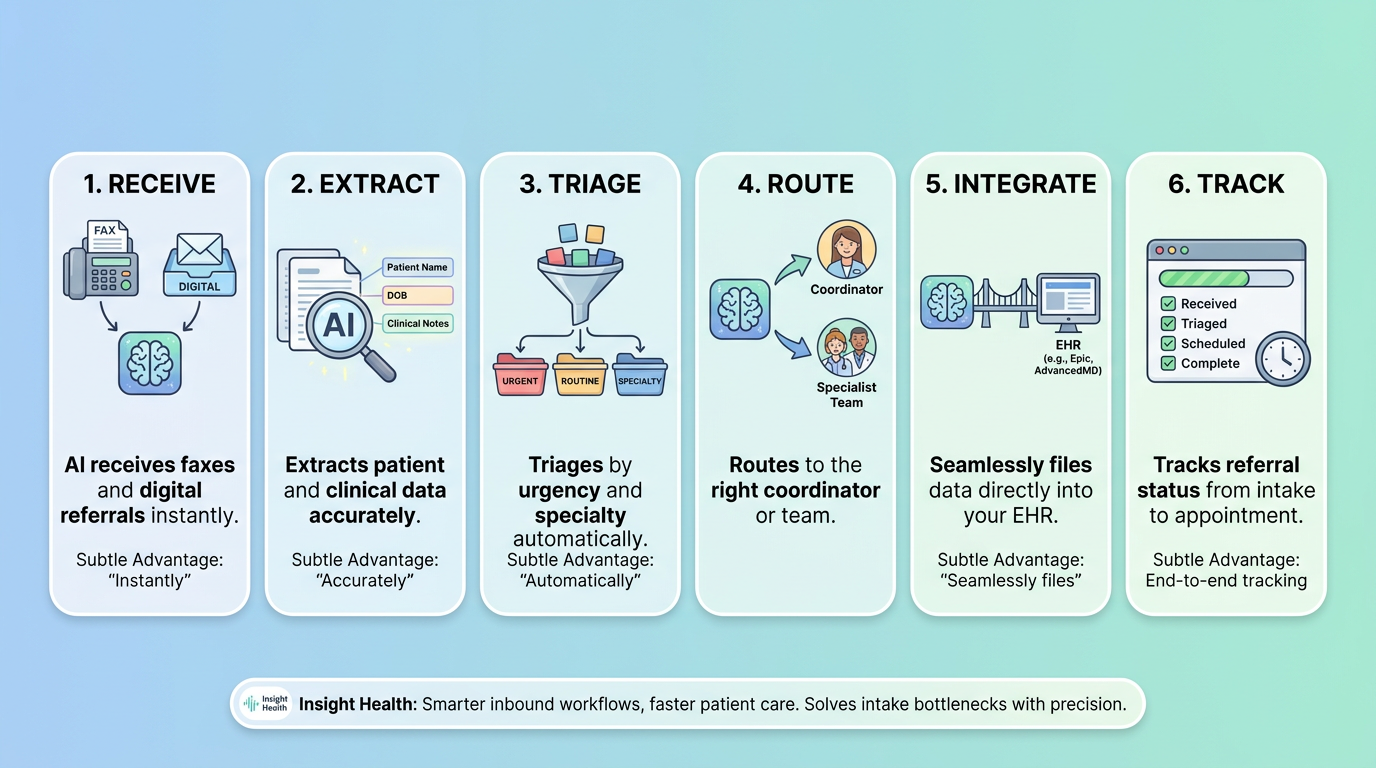
AI referral processing turns an incoming referral into a booked appointment with little manual work. Here is how AI processes an incoming clinical referral, start to finish. Our AI receives the referral by fax, email, or upload.
It then reads and extracts the clinical and demographic data. It matches the referral to the right patient, triages it by urgency, and routes it to the right specialist or queue. Structured data is filed into the EHR, and your staff review only the exceptions.
Inbound referral intake is the work of receiving a referral from an outside provider and turning it into a scheduled visit. It is the front door for new specialty patients, and it is mostly manual today.
We built our platform to run that whole path for you. Our end-to-end referral coordinator takes a referral from document received to visit booked. The document becomes the trigger for action, not just another page in a queue.
Referrals arrive through too many doors at once. They come by fax, email, patient portal, and scanned upload, and fax has not gone away.
Medical Economics reports research suggesting as many as 56% of referrals are still sent by fax. That happens often due to interoperability issues and a lack of effective information sharing between providers.
The documents themselves are messy. A single fax can run 15 to 30 pages, mixing the referral, labs, imaging, and pathology into one stapled packet. Staff read every page and re-key the data by hand.
That manual work creates delays, and delays lose patients. Some referrals often go uncompleted, and one JAMA Network Open cohort study found completion rates between 40% and 65% for all test types. That study looked at primary-care test and referral types, so treat it as one data point, not a universal rate.
For the front office, the pain is concrete. A coordinator can spend a full shift opening faxes, hunting for the ordering provider, and typing data into the chart. Every minute on data entry is a minute not spent moving a patient toward care.
Lost referrals are also lost revenue. One survey found the cost of referral leakage is steep: a typical 400-bed health system loses $6.2 million a year from avoidable leakage. Innovaccer's research put that at 270 to 315 basis points of operating margin.
When intake is slow, the whole downstream pipeline slows with it. Scheduling, insurance checks, and records collection all wait on that first read of the document.
The goal is simple. We want a referral to move from the fax line to a booked appointment with almost no manual touch. Every step leaves a clear record of what happened.
Our AI referral processing runs six named stages: Capture, Classify, Extract, Match, Summarize, and Route. This is intelligent document processing, which means AI that reads a document, understands its content, and acts on it. Here is what each stage does.
Every referral lands in one place. Our AI fax agent pulls each fax, e-fax, portal upload, and scanned record into a single queue across multiple fax lines and locations.
Capture runs 24/7, so a referral that arrives at 11 p.m. does not wait until morning. Nothing sits overnight in a machine no one checks.
For groups with several offices, this replaces a scatter of fax machines and shared inboxes with one dependable front door.
Delivery is reliable, too. A Canadian proof-of-concept study in JMIR Medical Informatics found reliable fax delivery is achievable, with 98.7% (2770/2806) of eFaxes delivered after automatic retries.
Basic tools stop at OCR. Optical character recognition (OCR) turns an image into text, but it does not understand what the text means. Intelligent document processing goes further, using natural language processing to identify the fields that matter.
Our AI extracts patient demographics, insurance, the ordering provider, the diagnosis, and the orders, even from handwriting. It also performs multi-document fax deconstruction, splitting a 15 to 30 page packet into discrete referral, labs, imaging, and pathology records.
The result is fast and accurate. Our platform reaches up to 99.5% field-level extraction accuracy on faxed clinical documents. It works in under 2 minutes per document, with zero keystrokes from your team.
Not every referral can wait its turn. Our AI applies specialty and urgency rules to prioritize each one. It flags anything that reads as urgent, so the right cases rise to the top.
This is well grounded. We build on peer-reviewed work showing that machine learning methods, including natural language processing and text similarity, can categorize referral urgency from clinical text.
Our triage is specialty-aware because it runs on 80+ specialty protocols developed by our physician founders, covering GI, orthopedics, cardiology, and more. A stroke workup and a routine follow-up should not sit in the same undifferentiated pile, and they do not here.
The AI proposes the priority. Your clinicians keep every clinical decision, and they can adjust any flag before a referral moves forward.
Next, the AI matches the referral to the right chart. It compares the extracted data against your destination EHR and assigns a confidence score to the match.
High-confidence matches route straight to the correct specialty queue or provider. Low-confidence or unmatched cases are surfaced for a person to review, and a likely new patient is flagged so no duplicate chart is created.
You can see this play out in our referral to appointment workflow, where a faxed orthopedic referral becomes a booked visit.
Finally, the structured data and follow-up tasks are written into the chart with a full audit trail. Our EHR integrations cover Epic, athenahealth, AdvancedMD, eClinicalWorks, NextGen, DrChrono, Elation, Charm Health, ModMed, Office Practicum, and more.
Status stays visible the whole way, which answers the search for automated referral tracking software. You can see where every referral stands without opening a spreadsheet.
Because the filing is EHR-native, it stays close to invisible to your care teams. They open the chart and the referral is already there, structured and tagged.
Speed matters here. At Stanford Health Care, automated fax triage shortened processing times for urgent faxed referrals from about 33 hours to about 1 hour. NEJM Catalyst reported the result in 2026.
Automation should never write guesses into a chart. Our S.A.F.E. architecture is supervised, self-evaluating, and multi-model verified, so accuracy is checked before anything is filed.
Inbound referrals are full of protected health information (PHI), so security is not optional. This is an area most competitors barely address, and it is one we treat as core.
Our platform is HIPAA compliant and covered by SOC 2 Type II controls. That is the audited standard for how a vendor protects customer data over time. We are BAA-ready, and all data is encrypted in transit and at rest.
Multi-model verification adds another check, comparing outputs before anything is written to the chart. That reduces the chance a single model's error reaches a patient record.
Trust also comes from who builds the product. Insight Health was founded by practicing physicians, including a neurosurgeon and a cardiologist, so clinical safety and privacy are designed in from the start.
The clearest way to see the value is to compare manual intake against AI-assisted intake. The table below uses our own first-party results.
On our referral management platform, AI referral processing delivers 95% extraction accuracy and about 2 minutes of processing per referral. Coordinators reclaim 15+ hours each week, leakage drops by 40%, and patients reach a specialist 3x faster.
Those hours do not disappear from the practice. They move to the work that needs a person, like calling patients, resolving insurance questions, and clearing the harder exceptions.
The broader opportunity is large. The 2025 CAQH Index identifies a remaining $21 billion automation savings opportunity across manual and partially manual transactions. That figure covers healthcare administration broadly, not referrals alone.
Yes, fax is still a standard way to send referrals, and our AI captures faxed, e-faxed, emailed, and uploaded referrals in one queue.
OCR only converts an image into text, while intelligent document processing reads that text, understands the clinical fields, and acts on them. That difference is why IDP can extract a diagnosis or ordering provider that OCR would miss.
The AI classifies the referral by specialty and urgency, matches it to the patient, and routes it to the right queue or provider. Uncertain cases are held for human review before anything is filed.
It means low-confidence or unmatched items are surfaced for a person to check rather than filed automatically. This keeps clinical judgment with your team while the AI handles the routine volume.
Our natural language processing extracts data from messy, multi-page packets and handwriting, then splits stapled documents into discrete records. Fields it cannot read with confidence are flagged for review.
Watch extraction accuracy, processing time per referral, reduction in manual review, coordinator hours saved, referral leakage, and time to a specialist appointment. Our own numbers include up to 99.5% accuracy and 40% less leakage.
Inbound referral intake does not have to bury your front office. AI can receive, read, triage, route, file, and track each referral, while your staff step in only for the exceptions that need a human.
Our platform is built by practicing physicians, HIPAA compliant, and covered by SOC 2 Type II controls. So you get speed without giving up safety or control. That is the outcome of AI referral processing: fewer lost referrals, faster appointments, and hours back for your team.

AI-Enhanced Healthcare with Insight Health
