The 2026–2027 Prior Authorization Playbook for Pain, Spine, and Orthopedic Practices
Prior Authorization Is Changing: What CMS-0057-F, FHIR PAS, eviCore CMM-200, and ESI Mean for Your Practice


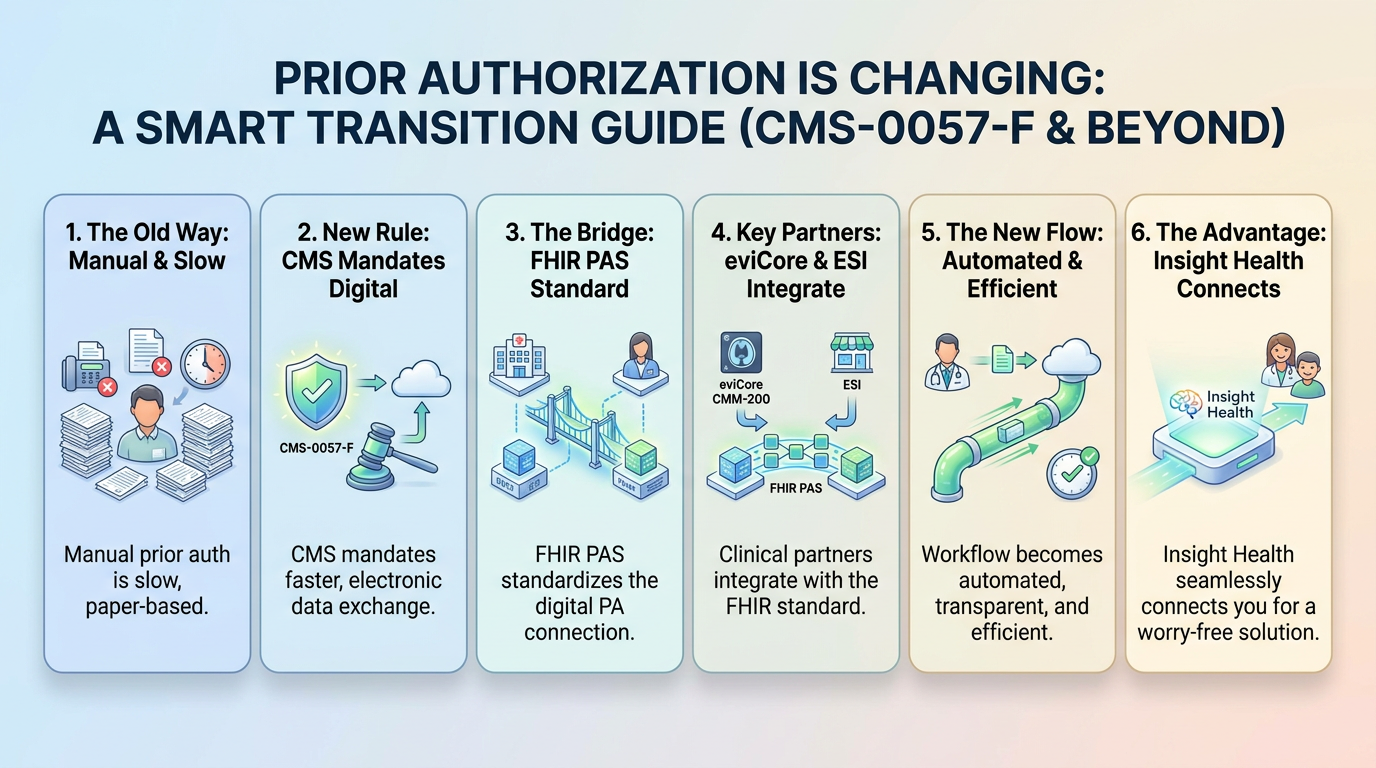
We can summarize the prior authorization changes ahead simply. Prior authorization is moving away from fax and phone toward standardized, electronic, deadline-bound workflows because of the CMS-0057-F final rule. At the same time, payers keep tightening the clinical criteria for procedures like epidural steroid injections.
We define prior authorization as a payer's approval that a service is covered before you provide it. This article covers four forces reshaping that process: CMS-0057-F, FHIR PAS, eviCore CMM-200, and ESI.
We wrote this for practice administrators and operations leaders in pain, spine, and orthopedics. You will learn what each change means and what to do next.
We see administrative burden as the staff time and cost spent on paperwork instead of patient care. Prior authorization is a leading source of it. The numbers show why teams feel buried.
According to the 2025 AMA physician survey, "On average, practices complete 40 PAs per physician, per week" and "Physicians and their staff spend 13 HOURS each week completing PAs." That is nearly two full workdays lost per physician.
The staffing effect is just as steep. The MGMA prior authorization landscape reports that "92% of surveyed medical group practices reported hiring or reassigning staff solely to handle the growing volume of PA requests."
The downstream cost lands on patients. In the same AMA survey, 95% of physicians report care delays, and 94% say prior authorization somewhat or significantly increases physician burnout. For procedure-heavy practices, a delayed approval means a delayed injection, surgery, or scan.
We define CMS-0057-F as the CMS Interoperability and Prior Authorization Final Rule. It sets new speed, transparency, and data-exchange requirements for certain government-regulated payers.
The rule applies to Medicare Advantage plans, Medicaid and CHIP fee-for-service and managed care, and Qualified Health Plans on the Federally Facilitated Exchanges. It does not apply to traditional Medicare or most commercial group plans. That scope limit matters, and many summaries get it wrong.
The rule rolls out in two phases. Operational provisions generally begin January 1, 2026. The API requirements, including the Prior Authorization API, are due generally January 1, 2027.
For a practice, the rule should mean faster answers and clearer denials. According to the CMS final rule fact sheet, impacted payers must decide "within 72 hours for expedited (i.e., urgent) requests and seven calendar days for standard (i.e., non-urgent) requests." QHPs on the Federally Facilitated Exchanges are excluded from that timeframe requirement.
Beginning 2026, impacted payers must also provide a specific reason for denied prior authorization decisions. That helps your team fix a packet instead of guessing.
Here is how the main requirements line up with their effective dates.
FHIR stands for Fast Healthcare Interoperability Resources. It is a shared data standard that lets health systems exchange information in a common format.
FHIR PAS, or Prior Authorization Support, is the standard that carries a request from your system to the payer. According to the Da Vinci PAS standard, the goal is to "define FHIR based services to enable a provider's system, at point of service, to request authorization (including all necessary clinical information to support the request) and receive immediate authorization."
In plain terms, PAS replaces faxing and re-keying data into payer portals. Your system sends the request and the clinical evidence, then receives an electronic response.
CMS recommends the Da Vinci PAS implementation guide for the required Prior Authorization API. PAS is the "how" behind the CMS "what."
Standardized APIs will speed the exchange of requests. They do not change the clinical bar a payer sets for approval.
For many spine and pain procedures, that bar runs through eviCore. Payers use its utilization-management guidelines to decide whether a procedure is medically necessary. This is where our pain and spine workflows focus.
An ESI is an epidural steroid injection, a common treatment for back and leg pain. eviCore CMM-200 is the utilization-management guideline for musculoskeletal and spine procedures, including ESIs.
Approval depends on the evidence in your documentation. According to the eviCore CMM-200 guideline, an initial ESI requires "Failure of at least four (4) weeks of conservative treatment (e.g., exercise, physical therapy, chiropractic care, or medications ...)."
That duration is not universal. It varies by plan, running roughly four to six weeks depending on the payer. Always confirm the version that applies to your patient.
A repeat ESI has its own bar. The prior ESI must be at least 14 days earlier. The record must also show pain relief of at least 50% for at least two weeks, plus active rehabilitation.
Missing any one of these details is a common, avoidable denial.
The net effect is mixed. You should see faster payer responses and clearer denial reasons. The work of assembling complete, criteria-matched documentation still sits with your practice.
Requirements are also expanding, with more procedures pulled into prior authorization over time. Faster APIs will not help if the packet is incomplete. Strong documentation up front is still what wins approvals and reduces handling denials and appeals later.
Use this checklist to prepare your team for the 2026 and 2027 milestones.
We apply automation where the work is repetitive and rules-based. Prior authorization is exactly that kind of work.
Our Prior Authorization Automation was built by practicing physicians, including neurosurgeon and cardiologist co-founders. It captures clinical encounter data in real time through our AI Scribe, rather than pulling from the EHR after the fact.
From there, the system does four things in sequence.
The outcomes are concrete. We reduce submission time from 45 minutes to under 5 minutes, and we target 90%+ first-pass approval versus the industry average of 70-80%. Our intelligent document processing achieves 99.5% extraction accuracy and captures and routes each document in under 2 minutes.
The platform is built for CMS-0057-F compliance, with FHIR PAS API readiness for the January 2027 mandate. See how this applies to orthopedic prior authorization and other procedure workflows.
The rule rolls out in two phases. Operational provisions generally begin January 1, 2026, and the API requirements are due generally January 1, 2027.
Most commercial group plans and traditional Medicare are not covered. The rule applies to Medicare Advantage, Medicaid and CHIP fee-for-service and managed care, and Qualified Health Plans on the Federally Facilitated Exchanges.
CMS-0057-F is the rule that says what impacted payers must do. FHIR PAS is the data standard that defines how a provider's system sends a request and receives an electronic response.
The rule speeds the exchange and clarifies denials, but payers still apply clinical criteria like eviCore CMM-200. An ESI is denied when the documentation does not show the required conservative care, interval, or pain relief.
No, you do not need to replace your EHR. You should confirm it can support electronic prior authorization and connect to the payer APIs arriving in 2027.
The rule will speed the exchange and make denials clearer. Complete, criteria-matched documentation still decides whether an approval comes back. That is the gap a physician-founded, specialty-aware prior authorization AI agent is designed to close.
We can show you where your practice is losing time today. Get a Free Fax / Referrals Audit.

AI-Enhanced Healthcare with Insight Health
