How AI After-Hours Answering Reduces Burnout for Care Teams
This article covers how AI after-hours answering works for medical practices, what to look for in a solution, and how to measure whether it's actually helping your.



This article covers how AI after-hours answering works for medical practices, what to look for in a solution, and how to measure whether it's actually helping your team and patients.
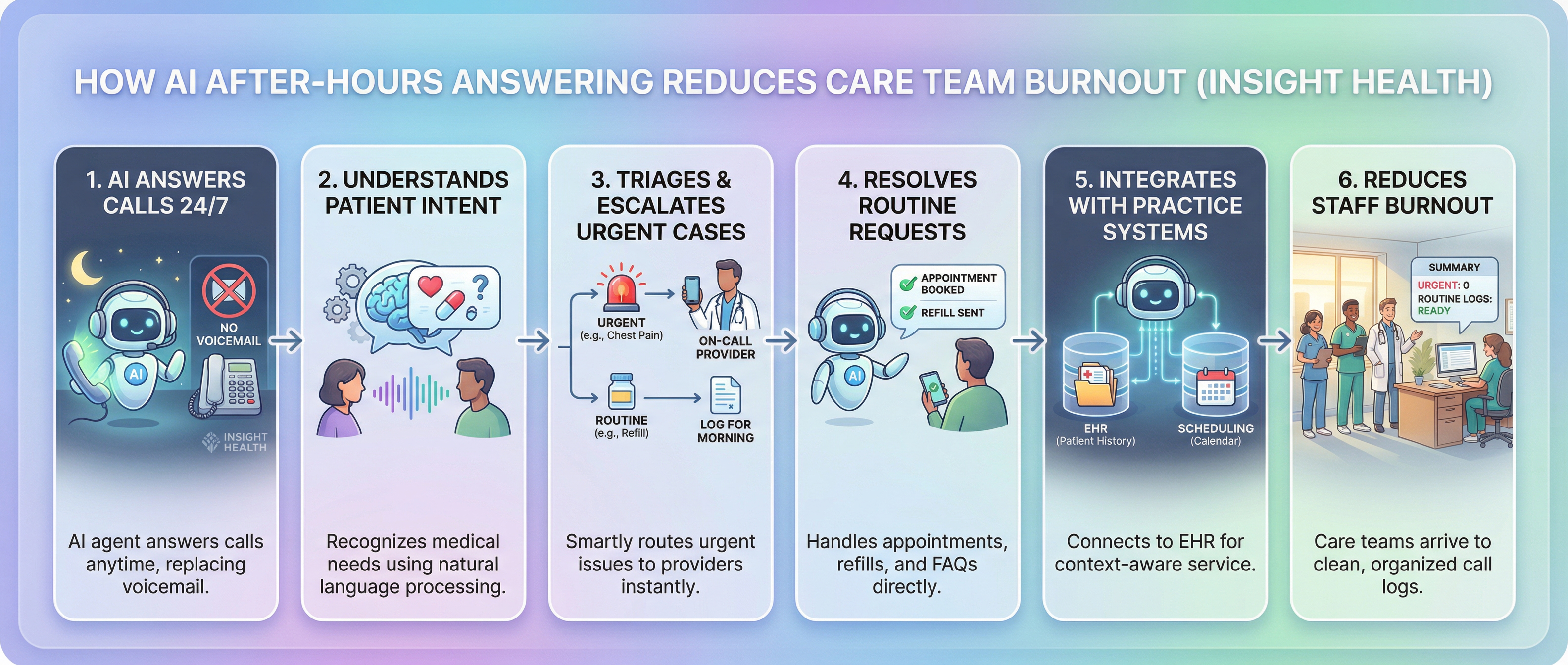
After-hours answering is a service that handles patient calls when your clinic is closed. An AI phone agent answers these calls, listens to what patients need, and either resolves their question directly or routes urgent cases to your on-call provider. Unlike voicemail, AI actually understands what patients are saying and responds appropriately.
When a patient calls at 9 PM worried about a medication side effect, they reach a system that listens and takes action. The AI captures their concern, asks clarifying questions if needed, and determines whether this can wait until morning or needs immediate attention. Patients feel heard even when your staff is offline.
Traditional answering services rely on human operators who may not understand medical terminology or your specific workflows. AI phone agents are different because they integrate with your systems and follow the protocols you set. They know the difference between a routine question and something that needs escalation.
Patients expect to reach someone when they call, even at night. When they hit voicemail, many hang up and either call back repeatedly or look for another provider. AI after-hours answering means every patient reaches a real response, not a recording asking them to call back during business hours.
The most immediate benefit is capturing urgent calls that would otherwise sit in voicemail until morning. A patient experiencing chest pain at 2 AM gets routed to your on-call physician within seconds, not hours. This faster escalation can make a real difference in patient outcomes.
Your front desk staff also benefits significantly. Instead of arriving to 30 voicemails that need to be triaged and returned, they see a clean summary of what happened overnight. Urgent issues were already handled. Routine requests are organized and ready for action. This alone can save your team 1 to 2 hours each morning.
Practices that implement after-hours answering often see improvements in patient satisfaction scores within the first few months. Patients remember when they could reach someone at night. They also remember when they could not.
AI phone agents use natural language processing to understand what patients are actually saying. This is different from old phone systems that only recognized keywords or required button presses. When a patient says "I need to refill my blood pressure medication," the AI understands the intent and takes appropriate action.
The AI connects to your existing systems, including your EHR and scheduling software. This means it has context about the patient before the conversation even starts. It knows their upcoming appointments, their medication list, and their care team. This context makes the conversation more efficient and accurate.
Here is how a typical after-hours call flows:
The best AI phone agents are specialty-aware. A cardiology practice has different workflows than a pediatric clinic. The AI needs to understand medical terminology, recognize urgency appropriately, and follow protocols that match how your specific practice operates. Platforms built by practicing physicians handle these nuances better because they understand real clinical workflows.
Choosing the right after-hours answering service requires evaluating how well it fits your existing workflows. The best solutions integrate directly with your EHR and practice management software so patient information flows seamlessly. You should not need to manually transfer data between systems.
Look for a solution built specifically for healthcare. Generic answering services do not understand the difference between a routine question and a symptom that needs immediate attention. They may escalate everything, which burns out your on-call staff. Or they may escalate nothing, which puts patients at risk.
You should also be able to adjust call routing rules without needing technical support. If your on-call schedule changes or you want to modify how certain calls are handled, you should be able to make those changes yourself. The system should work for you, not create more administrative burden.
Security is non-negotiable. Any solution you choose must be HIPAA compliant and ideally SOC 2 Type 2 certified. This means patient data is encrypted, access is controlled, and there are audit trails for every interaction. Ask vendors directly about their compliance certifications before signing anything.
After-hours answering handles several high-volume scenarios that would otherwise create problems for your practice. These are the calls that pile up overnight and create chaos the next morning.
Patients call at night with concerning symptoms. Your AI phone agent listens, asks relevant questions, and immediately escalates to your on-call provider if the situation is urgent. Critical cases never sit in voicemail.
The AI follows triage protocols you define. You decide what counts as urgent and where those calls route. This keeps your on-call provider focused on cases that truly need immediate attention rather than fielding routine questions at 3 AM.
Patients need to book or change appointments outside business hours. The AI checks your schedule in real time and offers available slots. If you prefer, it captures the request and sends it to your scheduling team for confirmation.
Either way, the appointment gets handled without a patient having to call back during business hours. This reduces callback volume significantly. Your front desk spends less time playing phone tag and more time helping patients who are actually in the office.
A patient calls at night needing a refill. The AI pulls their medication history from your EHR, confirms which prescription they need, and routes the request to your on-call provider with all relevant details attached.
Accurate medication capture prevents errors and speeds up fulfillment. The provider sees exactly what the patient needs without having to dig through records. This is especially valuable for practices with high refill volumes.
New patients or those needing updated information can complete intake forms over the phone during off-hours. The AI collects their information, confirms details, and passes it to your team before the appointment.
This reduces paperwork burden and makes the first in-person visit more efficient. Patients appreciate not having to arrive 20 minutes early to fill out forms. Your staff appreciates having complete information before the patient walks in.
Tracking a few key metrics helps you understand if your after-hours system is working. These numbers show whether patients are getting the service they need and whether your team is benefiting from the automation.
Review call transcripts regularly to identify patterns. If patients frequently ask questions the AI cannot answer, you can update your knowledge base. If certain call types are being escalated unnecessarily, you can adjust your triage protocols. The best systems learn and improve over time based on real interactions.
Every call should be logged, transcribed, and categorized. Practice managers can see call volume patterns, identify common patient questions, and spot operational bottlenecks. This data helps you make better decisions about staffing, hours, and patient communication.
With outpatient AI adoption nearly doubling since 2023, after-hours answering is becoming standard infrastructure for modern practices. Patients increasingly expect responsive care at any hour. Practices that deliver it will attract and retain more patients than those that send callers to voicemail.
The technology will continue improving at understanding medical nuance and integrating with clinical workflows. Tasks like insurance verification, referral coordination, and post-visit follow-up will become part of what AI phone agents handle automatically. The practices adopting this technology now are building the foundation for how healthcare communication will work going forward.
For practices facing a projected shortage of 141,160 physicians and rising call volumes, AI after-hours answering offers a way to do more without hiring more. You can provide better patient access, reduce staff burnout affecting 60% of healthcare workers, and improve operational efficiency all at once. The clinics implementing this today are already seeing measurable results.
The AI recognizes when it is uncertain and transfers the call to your on-call provider or escalates it as urgent. No patient is left unheard or stuck in a loop.
Yes, reputable solutions encrypt all patient data, store it securely, and follow all HIPAA requirements for handling protected health information.
Most solutions let you write custom greetings, responses to common questions, and escalation rules so the AI sounds like an extension of your team.
Setup typically takes a few days to a week, depending on how much customization you want and how complex your call routing needs are.
No, it supports your on-call staff by handling routine calls, capturing details, and escalating urgent cases so your provider can focus on critical situations.
Patients can request to speak with someone, and the AI will either transfer them to your on-call provider or capture their information for a callback.

AI-Enhanced Healthcare with Insight Health
