AI for Outbound Specialty Referrals: Send, Track, and Close the Loop
AI for outbound specialty referrals: send, track, and close the loop


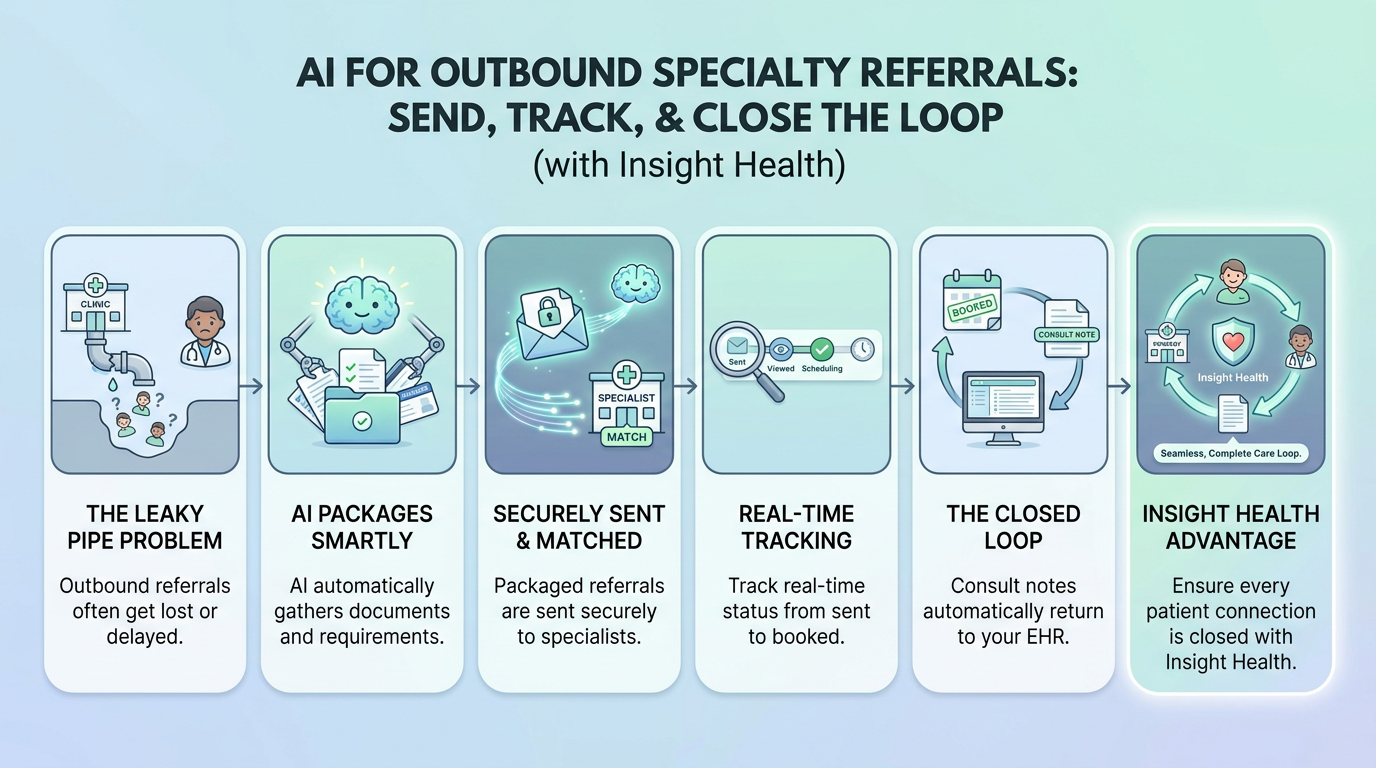
AI tools for outbound specialty referrals help a referring practice send a complete referral packet to the right specialist. They track each referral's status until the visit, then file the returning consult note back to the patient's chart.
The AI handles the routine checking and chasing. Your staff stay on the exceptions, by design.
An outbound referral is a referral your practice sends out to a specialist, such as a cardiologist or a gastroenterologist. Referral leakage is what happens when that patient never gets seen, or gets seen outside your network, and your team loses track of the care.
The data on this problem is limited but telling. A 2018 closing the referral loop study looked at one large academic health system's primary care network during FY2016. In that system, only 34.8% of referral scheduling attempts had a documented completed appointment.
That number counts scheduling attempts, not unique patients, and some visits may have happened without being recorded in the EHR (electronic health record). It is one system's snapshot, and it does not describe a national rate.
The gaps also run in both directions. The Dropping the Baton review is a 2011 literature review in the Milbank Quarterly. It found that primary care providers often do not know whether a patient saw the specialist, or what the specialist recommended.
We see the other side of this every day. We process referrals on the receiving side for specialty practices, so we know what makes a packet schedulable. In our experience, the most common reason a receiving office cannot book a patient is simple: the packet is missing something.
An outbound referral moves through five steps before the loop closes. One failure at any step can stall the whole referral. Step two includes prior authorization, which is a health plan's approval required before certain care is covered.
Completion rates vary a lot depending on how a study measures them. A referral can look open in your EHR even after the visit happened, simply because no one filed the note. That is why steps four and five deserve as much attention as step three.
A referral packet is the set of documents and data a specialist needs to accept, schedule, and prepare for a visit. When the packet is complete, the receiving office can act on it. When it is not, someone has to call or fax back, and the patient waits.
This is an old problem. A 2000 survey study cited in the CMS50 measure rationale found that 68% of specialists got no information from primary care before referral visits. That study is more than 25 years old, but it shows how long the gap has existed.
From the receiving side, these are the items a specialist office needs before it can schedule. Missing any one usually means a callback.
AI tools for outbound specialty referrals check the packet against the specialist's and payer's requirements before it leaves your office. That check needs to be specialty-aware. A GI procedure referral may need medication details, such as blood thinners, while a cardiology consult may need a recent ECG.
Insight Health was built by practicing physicians, including a neurosurgeon and a cardiologist. That clinical view shapes how our logic treats each referral type across 80+ specialties. To see what the receiving office does with your packet, read how specialists turn referrals into appointments.
An e-referral is a referral sent electronically through an EHR, portal, or direct message instead of by fax. E-referrals help, but they only work as well as the packet inside them. Some referrals also need prior auth before booking, which we cover on our prior auth automation page.
CMS-0057-F is the CMS Interoperability and Prior Authorization final rule. It requires impacted payers to support electronic prior auth through APIs, which are standard connections that let software systems exchange data.
According to the CMS-0057-F final rule page, impacted payers have until primarily January 1, 2027, to meet the API requirements. The rule binds payers, not practices. It covers prior auth and payer data exchange, and it does not govern referrals in general.
Here is our inference, which is not a CMS statement. As payers comply, coverage checks inside a referral workflow may get easier to automate. We are building our prior auth workflows for CMS-0057-F readiness, as a supporting step that feeds the referral pipeline.
Automated referral tracking software for healthcare gives every outbound referral a status and flags the ones that stall. Instead of a spreadsheet, your team works from one work queue, which is a shared list of tasks waiting for action.
Good referral tracking uses a short set of clear statuses.
Inside AI tools for outbound specialty referrals, the AI watches for acknowledgments and appointment dates. When a referral sits in one status past a set window, such as five business days with no scheduled date, it sends a nudge. If the nudge fails, it escalates the referral to a coordinator.
Task automation means the AI sends reminders and updates statuses. Decision support means the AI recommends a next step, like calling the patient or picking another specialist, and a person makes the call.
Humans stay on the exceptions by design. Tracking is also a coordination problem across channels. We built MagicFlow workflow coordination to run AI agents across phone, fax, referrals, and EHR work, including care transitions and provider handoff documentation.
On the MagicFlow page, we report that practices using MagicFlow see a 40% reduction in referral leakage and 3x faster time to specialist appointment. They also save 15+ hours per coordinator per week. For a team of four coordinators, that adds up to about 60 hours a week, or roughly 1.5 full-time roles.
A closed loop referral is a referral that ends with the specialist's report back with the referring provider. A consult note is that report, with the specialist's findings and recommendations after the visit.
The loop closes when the consult note is received, matched to the right patient, and filed. It goes to the chart and to the referring provider's in-basket, which is the provider's EHR inbox for results and messages.
In the practices we work with, many consult notes still arrive by fax. Our AI fax agent captures every fax, e-fax, portal upload, and scanned record into one queue across locations.
From there, AI document processing reads the note, matches it to the patient, and files it to the right chart. MagicDocs, our AI referral coordinator, does this today for inbound referrals and returning consult notes. On referral documents, we report 95% extraction accuracy, an 80% reduction in manual review time, and 2 minutes average processing per referral.
Every extracted field carries a confidence score. Low-confidence items are held for staff review rather than filed, and a full audit trail records what the AI did and what a person changed.
Closing the loop can also count for quality reporting. The CMS Quality ID 374 specification measures the percentage of patients with referrals for which the referring clinician receives a report from the specialist. It is an optional measure in MIPS, the Medicare Merit-based Incentive Payment System, so practices choose whether to report it.
Under the 2026 specification, only a patient's first referral made between January 1 and October 31 counts. A report can also state that the patient did not attend. The referring clinician is accountable for the measure, but the specialist has to send the report.
On the standards side, the ONC 360X project is a series of IHE specifications for tracking care transitions between the referring and receiving EHRs. ONC is the federal Office of the National Coordinator for Health IT, and IHE is a health IT standards group. 360X is voluntary, and we have not seen reliable data on how widely it is used.
When you compare AI tools for outbound specialty referrals, start with one distinction. Outbound referral software works for the sending practice. Referral management software, like our AI referral management for specialists, works for the receiving practice.
To be plain about our scope, Insight Health works on the receiving side and on capturing and filing returning consult notes. We do not build outbound referral packets or choose specialists for you.
HIPAA is the federal law that protects patient health information. A BAA (Business Associate Agreement) is the contract that holds a vendor to HIPAA. SOC 2 Type II is an independent audit of how well a vendor's security controls work over time.
Size your process to your group. At 10 to 50 providers, one administrator can usually decide, so press on time to value and price. At 50 to 100+ providers, plan for a committee with IT, security, compliance, and revenue cycle at the table.
Check every vendor's integration list against your EHR, the same way you would review our supported EHR integrations. We connect with 11+ EHRs, including Epic, athenahealth, eClinicalWorks, NextGen, and ModMed. Everything we build meets HIPAA and SOC 2 Type II standards.
They are software tools that help a referring practice send complete referrals, track each referral's status, and file the returning consult note to the chart. The AI handles routine checks and follow-up, while staff stay on the exceptions.
A closed loop referral ends with the specialist's report received, matched to the patient, and filed for the referring provider. If the note never comes back or never gets filed, the loop stays open.
Outbound referral software helps the sending practice package, send, and track referrals. Referral management software usually helps the receiving specialist read, triage, and schedule incoming referrals.
Some referral tools flag or start prior auth, but prior auth is a separate gate with payer-specific rules and timelines. Ask each vendor which prior auth steps the tool handles and which stay with your staff.
An eConsult is an electronic exchange where a referring provider asks a specialist a question and gets written advice without a patient visit. eConsults can replace some referrals when the patient needs guidance more than an appointment.
Referring offices and patients often call to check on referrals, so your phone lines show where the workflow stalls. Start with a free audit of how your calls connect to your referral and document workflow.

AI-Enhanced Healthcare with Insight Health
