AI vs. Traditional Patient Intake Software: A Side-by-Side Comparison
This guide covers the best automated patient intake software for clinics in 2025, including how each platform handles EHR integration, AI capabilities, and pricing so.


This guide covers the best automated patient intake software for clinics in 2025, including how each platform handles EHR integration, AI capabilities, and pricing so you can find the right fit for your practice size and workflow.
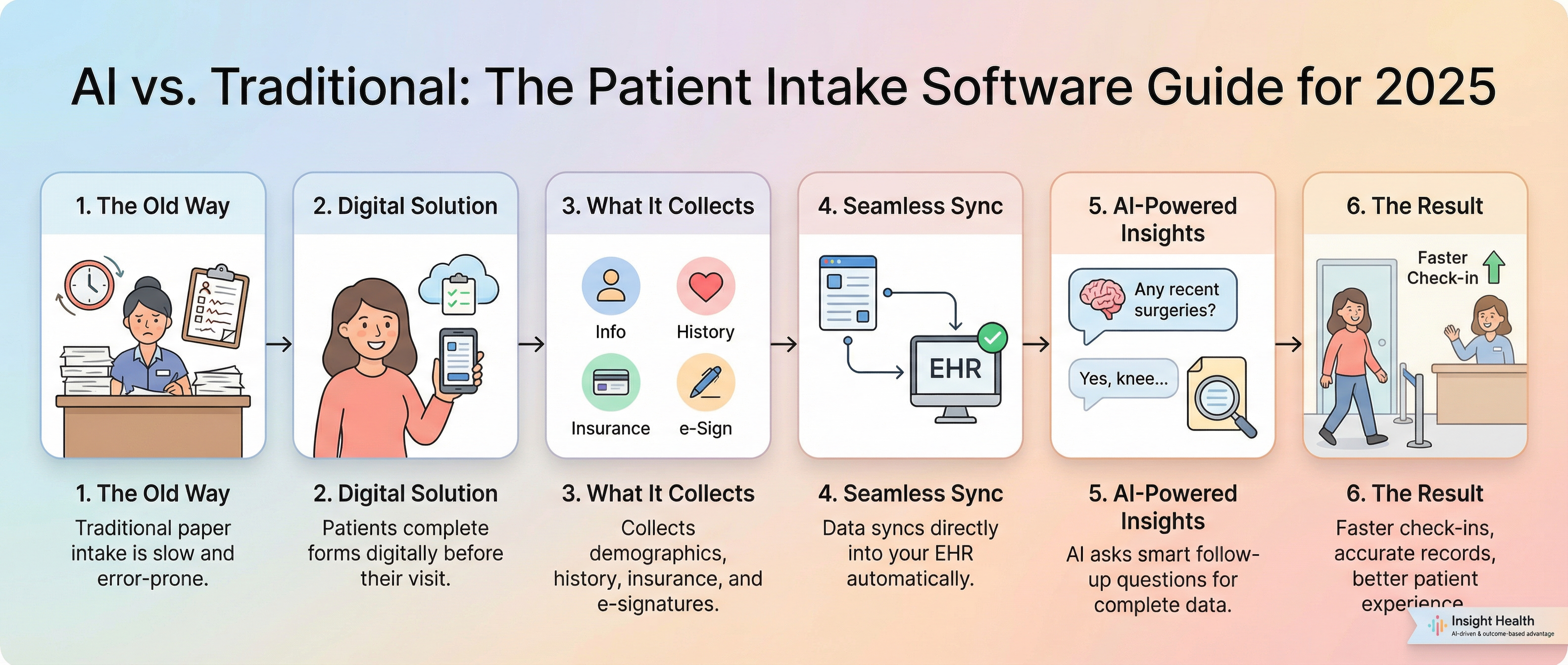
Automated patient intake software is a digital tool that collects patient information before appointments without paper forms or manual data entry. This means patients fill out their demographics, medical history, insurance details, and consent forms on their phone or computer before they arrive at your clinic.
The software syncs everything directly into your EHR or practice management system. Your staff no longer needs to type in patient information by hand, which eliminates transcription errors and saves hours each week — critical given that hospitals spend nearly $2 on administration for every dollar on direct patient care.
Modern intake platforms do more than just digitize forms. They use AI to ask follow-up questions based on what patients enter, adjust questions for different specialties, and support multiple languages. Some platforms include AI phone agents that conduct intake conversations over the phone for patients who prefer talking to typing.
What automated intake software handles:
Your patients already expect to handle most tasks on their phones. According to Experian Health's 2024 survey, 89% of patients rate the ability to use online and mobile tools as important. When they arrive at your clinic and receive a clipboard with paper forms, it feels outdated.
Automated intake lets patients complete everything before they walk through your door. This reduces wait times in your lobby and gets patients into exam rooms faster. Your front desk staff can focus on greeting patients and handling complex questions instead of entering data, reducing staff burnout.
For your practice, the benefits go beyond convenience. Digital intake improves data accuracy because required fields prevent incomplete submissions. Automated reminders reduce no-shows, which cost the U.S. an estimated $150 billion annually. And when patient information flows directly into your EHR, clinicians spend less time during visits correcting errors or asking questions that should have been answered beforehand.
Not all intake platforms work the same way. When I evaluate options for practices, I focus on a few key areas that determine whether the software actually reduces work or just shifts it around.
EHR integration depth matters most. The best platforms write data directly into your EHR without staff intervention. Some platforms only create PDFs that someone still needs to review and enter manually. Ask vendors specifically whether their integration is bidirectional and whether data populates into discrete fields in your system.
Customization should not require coding. Your practice has specific forms and workflows. You need a platform that lets you build custom intake packets, add conditional logic, and adjust questions for different visit types. If every change requires a support ticket and weeks of waiting, you will end up stuck with forms that do not fit your needs.
Pre-visit completion rates tell you if it works. A platform might look great in a demo, but what percentage of patients actually complete intake before arriving? If most patients still fill out forms on tablets in your waiting room, you have not solved the problem. Look for platforms with mobile-first design and automated reminders that drive completion before the appointment.
AI capabilities vary widely. Some platforms use AI to ask intelligent follow-up questions based on patient responses. Others just digitize your existing paper forms. AI phone agents can conduct intake conversations for patients who struggle with digital forms. These features matter if you want to capture complete, accurate information without staff chasing down missing answers.
I have evaluated the leading platforms based on their intake capabilities, EHR integrations, ease of use, and pricing transparency. Here is what I found.
Insight Health approaches intake differently than most vendors. The platform is built by practicing physicians, including a neurosurgeon and cardiologist, who understand clinical workflows from the inside.
The platform includes Lumi, an AI intake agent that captures patient history through natural conversation. Patients can complete intake by text or voice, and Lumi asks specialty-specific follow-up questions based on their responses. The system generates structured clinical notes that sync directly into your EHR.
What stands out is the pricing model. Instead of charging per provider or per month, Insight Health uses outcome-based pricing. You pay per completed intake or per successful automation. This aligns the vendor's incentives with your results.
Phreesia is the largest vendor in patient intake, used by thousands of health systems and practices across the country. The platform handles intake, scheduling, payments, and revenue cycle management in one integrated suite.
Phreesia also offers VoiceAI, an AI phone agent that handles scheduling, prescription refills, and billing questions. This helps practices reduce phone volume while maintaining 24/7 availability for patients.
The platform integrates with nearly every major EHR. However, Phreesia is built for scale, which means implementation takes longer and the dashboard has a steeper learning curve for staff.
Luma Health positions itself as an AI-native patient success platform. The system includes Navigator, an AI agent that handles voice and SMS conversations with patients across intake, scheduling, and reminders.
Luma integrates with more than 70 EHR and practice management systems. The platform recently acquired Tonic Health to expand its intake and e-consent capabilities.
This platform works best for large health systems and enterprise organizations. Implementation requires significant IT involvement, and pricing is not transparent.
Klara started as a secure messaging platform and added intake forms, appointment reminders, and telemedicine over time. The platform excels at reducing phone volume through two-way texting.
Patients do not need to download an app or remember a password. They receive a text link and complete forms directly in their browser. This reduces friction and improves response rates.
However, Klara's intake capabilities are lighter than dedicated intake platforms. If your primary goal is comprehensive pre-visit data collection, other options may serve you better.
Tebra is built specifically for independent practices and small groups. The platform combines EHR, practice management, billing, scheduling, and patient intake in one system.
Because intake is built into the EHR, patient information flows seamlessly from form to chart. Tebra recently added AI Note Assist for ambient documentation, which pairs well with automated intake.
If you already use a different EHR, Tebra's intake module may not integrate as deeply. This platform works best when you adopt the full suite.
Both platforms automate intake effectively, but they serve different practice types.
Insight Health works best for specialty practices that want AI-powered intake with transparent pricing. The platform captures information through natural conversation, supports more than 80 specialties, and charges based on completed intakes rather than provider seats. If you want to start with intake and expand to other AI agents for follow-up or phone triage, Insight Health offers that flexibility.
Phreesia works best for large health systems that need a comprehensive suite covering intake, payments, scheduling, and revenue cycle. The platform has the largest installed base and proven scale. If you have IT resources to support a longer implementation and want everything in one vendor, Phreesia delivers.
Both platforms emphasize AI-native architecture, but they differ in scale and transparency.
Insight Health focuses on clinical automation with modular AI agents you can adopt incrementally. Pricing is outcome-based, so you pay per completed intake. The platform is built by physicians who understand specialty workflows.
Luma Health is broader, covering the entire patient journey from search to payment. The platform is designed for large health systems with significant IT resources. Pricing requires a custom quote with no published structure.
These platforms solve different problems.
Insight Health focuses on capturing complete patient information before visits through AI-powered conversations. The platform generates structured clinical notes that sync into your EHR. If comprehensive pre-visit intake is your goal, Insight Health is stronger.
Klara focuses on reducing phone volume through two-way texting. Intake forms are available but lighter than dedicated platforms. If your primary pain point is phone calls and you want simple messaging, Klara works well.
Both platforms serve independent practices, but they differ in approach.
Insight Health integrates with your existing EHR and adds AI-powered intake on top. If you are happy with your current EHR and want to add automation without replacing your tech stack, this approach makes sense.
Tebra is an all-in-one platform that combines EHR, billing, scheduling, and intake. If you want to consolidate vendors or do not have an EHR yet, Tebra simplifies your setup.
The best choice depends on your practice size, existing systems, and what problems you need to solve.
For specialty practices focused on AI: Choose Insight Health. The platform is built by physicians, supports more than 80 specialties, and uses outcome-based pricing that aligns with your results.
For large health systems: Choose Phreesia or Luma Health. Both offer comprehensive feature sets covering intake, payments, scheduling, and analytics at enterprise scale.
For practices prioritizing messaging: Choose Klara. The platform reduces phone volume through two-way texting with minimal friction for patients.
For independent practices wanting one vendor: Choose Tebra. The all-in-one platform combines EHR, billing, scheduling, and intake in a single system.

AI-Enhanced Healthcare with Insight Health
