The Medical Practice Buyer’s Guide to HIPAA-Compliant AI Fax Automation
HIPAA-compliant AI fax automation for medical practices: a buyer's guide


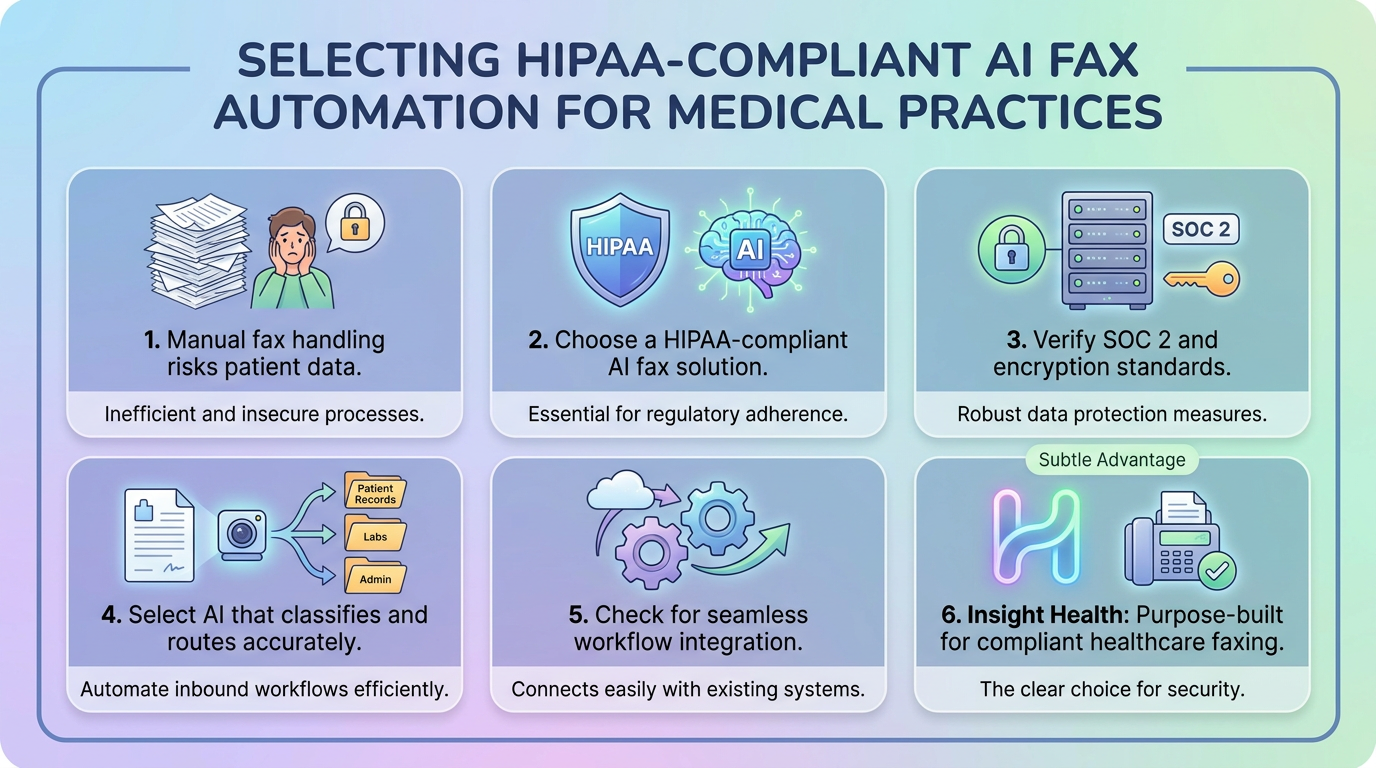
HIPAA-compliant AI fax automation for medical practices is software that receives inbound faxes, reads them, extracts the data, matches the patient, and routes it safely. It protects protected health information (PHI), meaning any health data that identifies a patient, at every step.
HIPAA is the federal law that sets national standards for protecting patient health information. We built our platform so PHI stays encrypted, access is limited, and every action is logged.
That is different from a plain fax tool. A HIPAA-compliant fax service transmits a document securely, then hands your staff a stack of pages to sort by hand.
HIPAA-compliant AI fax automation goes further. It reads and acts on what is inside each document. A referral or clinical record becomes chart-ready work instead of another item in the queue.
Most competing answers blur these two things together. The line matters when you are the one signing the contract. We wrote this guide for administrators and operations leaders at specialty groups, MSOs, and health systems with 10 to 100+ providers.
We still see fax running the front office because payers, referring offices, labs, and pharmacies keep sending it. As of 2019, 89% of healthcare leaders in an MGMA fax poll reported their organization uses a fax machine.
The work behind those pages is still manual. According to the 2024 CAQH Index, only 35% of medical prior authorizations are fully electronic, and manual requests average 24 minutes versus 10 minutes electronically.
Every inbound fax is unstructured PHI. Someone has to open it, sort it, find the patient, and key it in. That is slow and error-prone.
It is also a privacy exposure. A misrouted fax or a document filed to the wrong chart is a PHI-handling risk, not just an annoyance. So fax volume is both an operational cost and a compliance problem you own.
HIPAA-compliant AI fax automation only works if the vendor meets HIPAA's safeguards on your behalf. When faxes carry PHI, those safeguards are what protect it.
The safeguards below are the ones to demand in a security review. Each one is something you can verify before signing.
Encryption in transit protects a fax while it moves between systems. Encryption at rest protects it once the document is stored.
Once a fax is saved as a digital file, it becomes electronic PHI, or ePHI. That record is then governed by the HIPAA Security Rule, a nuance most fax pages skip.
The HIPAA Security Rule technical safeguards at 45 CFR 164.312 require access controls, audit controls, and transmission security for electronic PHI. The rule also requires a signed business associate agreement, or BAA, under 45 CFR 164.308(b), before a vendor handles PHI. A BAA is the contract that makes a vendor legally responsible for protecting your PHI.
Encryption is the practical standard for any vendor that touches PHI.
Not everyone should see every document. Access controls limit each document to the people who are authorized to view it.
Role-based access matters most across sites. At an MSO or a multi-location group, one inbox with role-based permissions keeps each site seeing only its own work. You can read how we handle PHI for the specifics.
Every action should be logged and reviewable. An audit trail records what the AI did and what a person changed. That lets you show a reviewer exactly how a document moved.
The BAA is non-negotiable. No vendor should touch your PHI without one signed first. Together, the audit trail and the signed BAA are usually what clear an enterprise security review.
SOC 2 Type II is an independent audit of a vendor's security, availability, and confidentiality controls over a period of time. It shows the controls work in practice, not just on paper.
HIPAA plus SOC 2 Type II together is the bar for an enterprise security review. HIPAA sets the legal standard, and the audit gives your IT and compliance leads outside evidence. This is a selection criterion, not an adoption statistic.
We are HIPAA compliant and SOC 2 Type II certified, with a BAA on paid tiers. You can review our SOC 2 Type II controls as part of your evaluation.
Safe automation is a pipeline, not a black box. We capture a fax, break it into discrete documents, classify each one, read it, match the patient, and route the result.
Safety comes from two things: confidence scoring on every extracted field, and a human on the exceptions. The AI does the repetitive reading, and your staff stays on the judgment calls.
Our Fax AI Agent owns the fax line. It captures every fax, e-fax, portal upload, and scanned record into one queue across locations.
MagicDocs, our AI referral coordinator, does the rest. It handles the AI document processing that follows: intelligent document processing that deconstructs multi-document fax bundles into discrete items, then classifies each document type. It extracts the fields, including handwriting, and matches the patient with a confidence score.
The numbers matter to the buyer. In Insight Health production data, MagicDocs reaches up to 99.5% extraction accuracy on faxed clinical documents. It reads, structures, and routes each document in under 2 minutes.
Humans stay on the exceptions by design. Confidence scoring sends low-confidence items to a human review queue, never silently into the chart.
That safety posture runs on our S.A.F.E. architecture, the Supervised Autonomous Framework for Evaluations. It is supervised, self-evaluating, and multi-model verified, with de-identification and confidence scoring built in.
Our platform is built by practicing physicians who are also co-founders. So the logic reflects how documents actually move through a specialty practice. The AI never replaces clinical or administrative judgment.
See our AI fax agent page for how capture and routing fit together.
Use this checklist in your security review and your business case. Each criterion ties to a metric you already report upward. It also frames the HIPAA-compliant AI fax automation software questions to ask each vendor.
Be honest with yourself about the last row. Any tool asks something of your team during rollout, so plan for a short ramp.
Integration depth is where deals stall, so confirm the supported EHR integrations cover your systems. We support 11+ EHRs, including Epic, athenahealth, eClinicalWorks, and NextGen.
The burden is measurable, which is why the checklist matters. An AMA prior authorization survey of 1,000 physicians in late 2024 found 39 prior authorization requests per physician each week, taking about 13 hours.
The payoff shows up in the numbers you take to a CFO. In one Insight Health deployment, a 30-provider gastroenterology group cleared a year-long referral and colonoscopy recall backlog.
The group cut cancellations by more than 16% and reduced manual document review by 80%. Administrators moved four staff members to higher-value work and saved $250,000 a year.
That is what recovered referral leakage and reclaimed staff hours look like at scale. For the routing side of that story, see our fax-to-EHR automation guide.
Regulation is steadily pushing the industry toward electronic alternatives to fax. Under the CMS Interoperability and Prior Authorization Final Rule, known as CMS-0057-F, impacted payers must implement FHIR-based prior authorization APIs by January 1, 2027.
These are called FHIR PAS APIs, which let payers receive and return prior authorization requests electronically. FHIR is a shared standard for exchanging health data between systems. This January 2027 payer mandate is the deadline for those payer APIs.
Fax will not disappear overnight, though. We expect fax to stay common in referral, lab, and pharmacy workflows for years. A HIPAA-compliant AI fax automation layer bridges that gap, so your practice stays covered while the industry transitions.
Yes, when the vendor signs a BAA, encrypts PHI in transit and at rest, enforces access controls, and keeps a person on low-confidence items. Compliance comes from the vendor's controls, not a label on the website.
A fax service transmits documents securely from one line to another. AI fax automation also reads, classifies, matches, and routes each document, with safeguards for the PHI inside it.
No. Our AI handles the repetitive reading and routing, and your people stay on the exceptions and anything that needs clinical or administrative judgment.
Most deployments start with one fax line and expand from there. In our rollouts, practices often see reclaimed hours and a shrinking backlog within the first weeks, not months.

AI-Enhanced Healthcare with Insight Health
