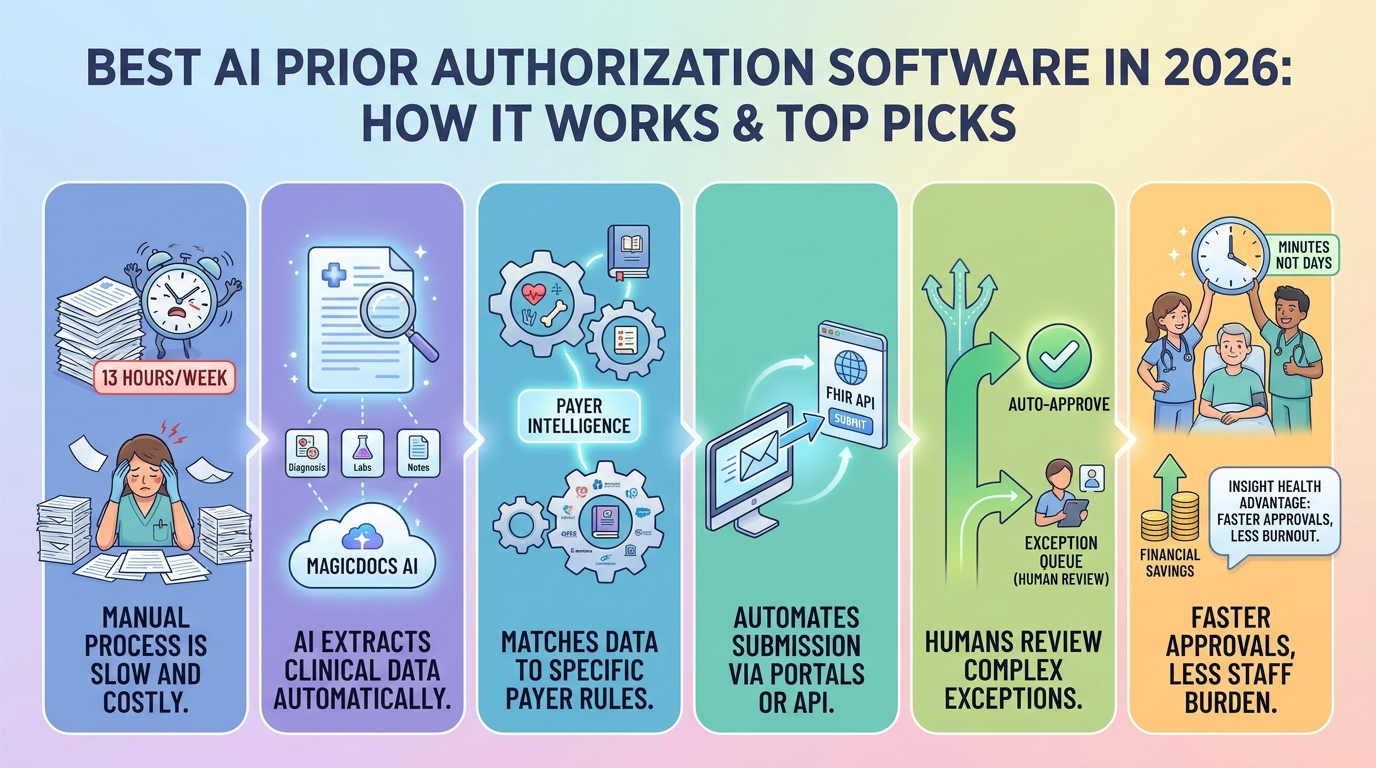
Physicians and their staff spend an average of 13 hours each week on prior authorization, according to the American Medical Association. AI prior authorization software can now handle most of that work automatically. This guide explains how these tools work, which features matter most, and reviews the best options in 2026.
Prior authorization is the approval process you complete before insurers agree to cover certain treatments, procedures, or medications. AI prior authorization software automates this traditionally manual process. CMS estimates this costs $34,000 per provider annually.
These tools connect directly to your EHR and insurance company portals. When you order a treatment that requires approval, the software extracts clinical data from the patient's chart. It matches that data against payer requirements and submits the request electronically.
The core capabilities include:
Real-time data extraction: pulls clinical information directly from patient records and eliminates manual chart reviews.
Payer rule matching: applies insurance-specific clinical criteria continuously to reduce denials.
Automated submission: fills out, signs, and submits requests directly to payers without staff intervention.
Faster decisions: returns authorization decisions on qualified cases in minutes rather than days.
For practices completing dozens of prior authorizations weekly, this automation recovers staff hours and speeds patient access to treatment.
How AI prior authorization software works
AI prior authorization software runs a multi-step workflow that reduces manual touchpoints while keeping clinicians in control. Here is how the automation works, step by step.
Determine whether prior authorization is required for the payer, plan, and specific service.
Gather and extract the diagnosis, notes, labs, imaging, and payer-specific documentation, using intelligent document processing to read each clinical document.
Match the record against payer-specific clinical criteria to confirm medical necessity.
Submit through the payer's available channel, whether API, portal, or fax.
Track status, follow up, and route denials, appeals, and low-confidence items to staff.
Humans stay on the exceptions by design. The software clears routine cases and holds anything uncertain for a person to review.
At rollout, staff map payer workflows, validate rules, and work the exception queue. The software also monitors authorization expiration dates and alerts your team to renewals before appointments.
Procedure-level automation is where this pays off. Strong platforms apply payer-specific and procedure-specific criteria for high-friction procedures such as epidural steroid injections, colonoscopy, and advanced imaging. They capture required documentation at the point of care and flag gaps before submission, so fewer requests come back for missing information.
Denials and appeals follow the same logic. When a payer denies a request, the software parses the reason, pulls supporting evidence from the note, and drafts an appeal for staff review.
Low-confidence extractions and clinical judgment calls route to a person, not to auto-submit. That keeps the exception queue small and the audit trail complete.
7 best AI prior authorization software tools for 2026
I have reviewed the leading AI prior authorization solutions available today. Each serves different practice sizes and specialties, so I have organized them by primary strength.
Some are built for provider practices, some for payers and PBMs, and some for enterprise health systems. Read each entry for the practice profile it fits before you shortlist.
1. Insight Health
Insight Health is the most complete provider-side AI prior authorization solution on this list. It is physician-founded, built by practicing physicians who are also co-founders. It treats prior authorization as an extension of its referral and document rails, not a standalone tool.
The core of the platform is referral, document, and fax intake. MagicDocs reads every inbound document and extracts clinical and administrative data at 99.5% accuracy in under 2 minutes per document. That same referral coordination workflow feeds prior authorization, so the record is chart-ready before a request is built.
The Prior Authorization AI Agent extends those rails. Insight Health captures encounter data in real time through Aura AI Scribe, then scores documentation against payer-specific and procedure-specific criteria before submission. Its payer intelligence is specialty-deep across 60+ specialties, tuned for high-friction areas like pain management, neurosurgery, orthopedics, gastroenterology, and oncology.
The criteria engine shapes documentation upstream rather than only checking submissions for completeness. It prompts structured capture at the right moment in the visit, detects ICD-10 coding errors, and flags gaps before submission.
The platform is modular. You can start with the Aura AI Scribe, add referral-moment pre-screening, and layer in submission automation as volume justifies. It integrates with 11+ EHRs, including Epic, athenahealth, AdvancedMD, DrChrono, and eClinicalWorks.
Every extracted field carries a confidence score, and humans stay on the exceptions by design. The platform is supervised in production by the S.A.F.E. architecture with a full audit trail.
It meets HIPAA and SOC 2 Type II standards with a standard BAA. HIPAA governs how patient health information is protected, and SOC 2 Type II verifies security controls over time.
The platform is also built for FHIR PAS. FHIR PAS is the standard API workflow for exchanging prior authorization requests and responses electronically. That readiness supports CMS-0057-F, the rule requiring impacted payers to move prior authorization to FHIR APIs by January 1, 2027.
The results show up across the practice. In one 30-provider gastroenterology group, Insight Health cut manual document review by 80% and saved about $250,000 a year.
In pilot-stage research for pain management practices performing epidural steroid injections, Insight Health projects submission time dropping from about 45 minutes to under 5 minutes. It targets a first-pass approval rate above 90%. These are pilot-stage projections from research, not deployed results.
Main features:
Prior auth eligibility, insurance nuances, and documentation requirements at referral moment.
External records via pre-visit screening to reduce post-visit denials.
Specialty-deep payer intelligence per procedure and payer.
Modular deployment across AI scribe, policy engine, pre-screen, submission, or full workflow.
Aura AI Scribe with criteria-aware structured capture at point of care.
Payer portal submissions with FHIR Da Vinci PAS readiness for January 2027.
Denial parsing and AI appeals tied to specific evidence in notes.
ICD-10 and CPT coding suggestions to reduce documentation burden.
HIPAA and SOC 2 Type II compliance with standard BAA.
Integration with Epic, athenahealth, AdvancedMD, DrChrono, eClinicalWorks, and other major EHRs.
Ideal for: Specialty practices in pain management, neurosurgery, orthopedics, gastroenterology, and oncology where procedure prior authorization is high-volume and high-friction. Practices that want a workflow-integrated solution that activates at referral rather than only at submission. Organizations seeking specialty-deep payer intelligence rather than generic rule libraries.
Pricing: The Prior Auth Intelligence Platform uses outcome-based pricing tied to approved authorizations and reduced denials.
2. Availity AuthAI
Availity AuthAI is the AI-powered prior authorization engine from Availity, connecting providers to over 170 insurance plans. The platform delivers authorization recommendations in under 90 seconds by applying each plan's specific medical criteria to your patient's clinical data.
Availity's strength lies in its transparency. Rather than using a black-box machine learning model, AuthAI uses analytical AI grounded in each payer's actual clinical policies. This means recommendations are fully traceable and auditable, so your team understands why a case was approved or flagged.
The platform is built for CMS-0057-F compliance with FHIR-native APIs ready for January 2027 requirements.
Ideal for: Practices wanting explainable, transparent AI prior authorization. Organizations concerned about denial bias and auditability.
Pricing: Custom enterprise pricing based on volume and payer network scope.
3. Myndshft
Myndshft is a unified prior authorization solution for both medical and pharmacy benefits. Now part of DrFirst, the Myndshft platform provides eligibility and benefits verification for 95% of insured patients in the United States and verifies prior authorization requirements for more than 600 payers and thousands of health plans, as of the April 2024 DrFirst acquisition.
The platform automates requirement identification, submission, monitoring, and adjudication across payer portals, EDI 278 transactions, and fax. Its self-learning rules engine adapts to policy changes automatically, reducing the manual updates payers usually require.
Ideal for: Mid-sized practices that want AI-driven determination as a centerpiece, not an add-on. Practices managing both medical and pharmacy authorizations.
Pricing: Custom enterprise pricing based on transaction volume and integrations.
4. Banjo Health
Banjo Health provides an AI-assisted prior authorization workflow platform designed primarily for payers and PBMs that want to streamline internal review. The platform includes BanjoPA for intake-agnostic capture and automated clinical review, plus Composer for building clinical decision trees without code.
Banjo's CARE engine surfaces clinical evidence during review to accelerate decisions while keeping clinicians in control. The platform is HITRUST r2 certified and accepts prior authorization requests from any source, whether fax, digital submission, or portal.
Ideal for: Payers and pharmacy benefit managers. Organizations needing flexible intake from multiple submission sources.
Pricing: Custom pricing based on members, transaction volume, and workflow complexity.
5. Humata Health
Humata Health focuses on eliminating friction in the prior authorization process through intelligent automation embedded directly in your EHR workflow. The platform detects authorization requirements automatically, retrieves payer policies in real time, and bundles clinical evidence for submission.
Humata's PolicyLink feature retrieves and applies payer-specific requirements without manual lookup. It also includes intelligent gold-carding to reduce repeat authorizations for stable patients.
Humata Health is one of six technology companies designated by CMS as a WISeR Model participant, assigned to Oklahoma to process WISeR prior authorization requests for traditional Medicare providers. That makes it a fit for practices serving Medicare populations in that program.
The WISeR Model is a six-year CMS pilot running 2026 through 2031 in Arizona, New Jersey, Ohio, Oklahoma, Texas, and Washington. It applies AI-assisted prior authorization to 13 elective Part B services in traditional Medicare, not Medicare Advantage.
Ideal for: Practices serving Medicare populations. Organizations seeking deep EHR integration and automated policy retrieval.
Pricing: Custom enterprise pricing based on payer connections and integrations.
6. Tandem
Tandem automates the entire prior authorization and medication access journey from prescription to patient delivery. The platform is free for providers and patients, positioning itself as a consumer-friendly alternative to traditional prior auth software.
Tandem handles prior authorizations, appeal letters, and enrollment forms, then conducts pharmacy and payer calls on behalf of your practice. It tracks prior auth renewals, routes prescriptions to the patient's preferred pharmacy, finds financial assistance programs, and texts patients updates. Most prior authorizations are completed within 24 hours.
Ideal for: High-prescription clinics, particularly primary care, psychiatry, dermatology, oncology, and rheumatology. Practices wanting a free solution for medication access.
Pricing: Free for providers and patients.
7. Innovaccer
Innovaccer is a data activation platform for health systems that want to fold prior authorization into a broader clinical intelligence and population health strategy. The platform unifies multi-source clinical and claims data, then applies AI agents to automate workflows including prior authorization.
Innovaccer's strength is its enterprise-scale data integration and governance. The platform supports FHIR Level 4 interoperability and SMART on FHIR apps, making it flexible for organizations with complex EHR environments.
Ideal for: Large health systems and payers. Organizations with complex data environments needing unified analytics alongside workflow automation.
Pricing: Custom enterprise pricing based on deployment size, users, and scope of modules.
What to look for in AI prior authorization software
When I evaluate prior authorization software, I prioritize features that reduce manual work while maintaining clinical oversight. Your software should integrate with your specific EHR so prior auth workflows feel native to your existing processes. Avoid tools that require staff to toggle between multiple systems.
Look for platforms with direct connections to your most common insurance plans. That reduces reliance on fax and phone submissions. The software should also update payer policies and clinical criteria automatically as they change, because manual policy management creates bottlenecks and increases denial rates.
The best tools keep clinicians in control rather than fully automating decisions. Your team should review complex cases and see exactly why the AI recommended approval or denial.
Ensure the platform meets HIPAA and SOC 2 Type II standards, and confirm it maintains detailed audit trails for compliance and appeals. For payer-facing tools, HITRUST certification is increasingly expected.
Finally, weigh how the tool measures itself. Ask for reporting on days to authorization, first-pass approval rate, staff hours per document, referral leakage, and time from referral received to appointment booked. A platform that surfaces its own performance is easier to defend at renewal than one that only reports volume.
Be just as clear about limits. These tools do not fully replace staff judgment, and rollout asks your team to map payer workflows, validate rules, and review the exception queue. A vendor that names those limits is easier to trust.
Feature | Why it matters |
|---|
EHR integration depth | Workflows feel native to existing processes. |
Real-time payer connectivity | Reduces reliance on fax and phone submissions. |
Policy currency | Automatically updates as payer rules change. |
Human-in-the-loop design | Clinicians retain control over complex cases. |
Compliance certifications | HIPAA, SOC 2 Type II, HITRUST for audit readiness. |
Specialty-specific capabilities | Understands your specialty's unique requirements. |
How to choose the right software for your practice
The right choice depends on your practice profile, not on the longest feature list. As the administrator who owns the budget, start by matching the tool to how your group buys and operates.
Mid-market specialty groups with 10 to 50 providers usually want speed to value, a clear price signal, and one decision-maker who can move in weeks. If that is you, weigh time to first result and a price you can take to your CFO.
Enterprise groups, MSOs, and health systems with 50 to 100+ providers run the decision through a committee. That group wants a security review, audit trails, multi-location routing, integration depth, and references at comparable scale. Ask each vendor to prove all five before a pilot.
Then factor in the specifics: your specialty mix, your EHR, and your payer mix. A pain management group performing epidural steroid injections needs different procedure-level criteria than a primary care group managing pharmacy authorizations.
Ask each vendor for a number you can take to a board. Push for staff hours reclaimed per week, cost per document, first-pass approval rate, days to authorization, referral leakage, and headcount avoided.
Then ask which EHRs are live in production today, not on a roadmap, and where a human stays in the loop.
Benefits of AI prior authorization software for healthcare practices
Implementing AI prior authorization software delivers measurable benefits across clinical, operational, and financial dimensions. Patients begin treatment sooner when approvals happen in minutes rather than days. Your nurses, medical assistants, and front desk team spend less time on authorization calls and paperwork.
For the administrator who owns the budget, the benefits map to metrics you already report. Fewer touch-based submissions mean lower cost per document, and reclaimed staff hours translate into headcount avoided.
Faster decisions shorten days to authorization, while cleaner documentation lifts first-pass approval and cuts rework. Each of these is a number you can bring to a CFO or board.
Two in five physicians (40%) employ staff who work exclusively on prior authorization, according to the American Medical Association. The same AMA survey found 93% report that it delays patient care. Automation reclaims that capacity and reduces burnout.
The financial case is just as direct. Manual prior authorization costs providers an average of $12.88 per transaction, versus $5.38 when handled electronically, according to the 2024 CAQH Index. Faster, cleaner submissions also speed claims processing and improve revenue cycle timelines.
AI software ensures submissions include all required clinical information and align with payer criteria before they go out. That reduces denials and the costly appeal process. Platforms with built-in compliance features and audit trails also simplify regulatory reviews.
Regulation is a reason to act now. CMS-0057-F is the CMS Interoperability and Prior Authorization final rule. It requires impacted payers to support electronic prior authorization through FHIR APIs by January 1, 2027.
The rule covers Medicare Advantage, Medicaid managed care, CHIP, and Qualified Health Plans. Many platforms also provide analytics on denial patterns, payer trends, and authorization timelines to help you find process improvements.
Frequently asked questions about AI prior authorization software
Will AI prior authorization software replace my clinical staff?
No. AI prior authorization software eliminates routine, repetitive tasks so your staff can focus on complex cases and patient care. Your team will still review complex authorizations, handle appeals, and manage exceptions.
How long does implementation typically take for prior authorization software?
Implementation timelines vary based on your EHR system and the software's integration depth. Simple integrations may take weeks, while complex enterprise deployments may take months. Plan for your team to grant EHR access, map payer workflows, validate rules, and train on the exception queue.
Does AI prior authorization software work with regional insurance companies?
Most software supports the largest national payers, but smaller regional insurers may not be included. Verify that your software supports your most common payers before purchasing.
Is patient data safe with AI prior authorization software?
Reputable vendors are HIPAA and SOC 2 Type II compliant with strict data security protocols. Request security documentation and compliance certifications before signing a contract.
What is the best AI prior authorization software?
The best fit depends on your practice size, specialty mix, EHR, and payer mix. Provider-side specialty groups should prioritize procedure-level payer intelligence and an EHR-native workflow. Payers and PBMs need different tools built for internal review.
How much does AI prior authorization software cost?
Pricing usually follows one of three models. Some vendors charge per-transaction fees, others charge monthly subscriptions, and some use outcome-based pricing tied to approved authorizations.
Does AI prior authorization software work with my EHR?
Most tools integrate with major systems like Epic, athenahealth, eClinicalWorks, NextGen, and AdvancedMD. Integration depth varies, so confirm which systems are live today and how deep the connection goes.
What is the WISeR model for Medicare prior authorization?
WISeR is a six-year CMS pilot running 2026 through 2031 in Arizona, New Jersey, Ohio, Oklahoma, Texas, and Washington. It covers 13 elective Part B services in traditional Medicare, not Medicare Advantage. Consult your own compliance team on how it applies to your practice.
What first-pass approval or denial rates should I expect?
Treat published rates as physician-reported perception, not a national benchmark. Reported experience varies widely by specialty and payer. Stronger documentation upstream is the main lever for improving first-pass approval.