Best AI Fax and Referral Intake Software for Specialty Practices in 2026
Best AI fax and referral intake software for specialty practices (2026)


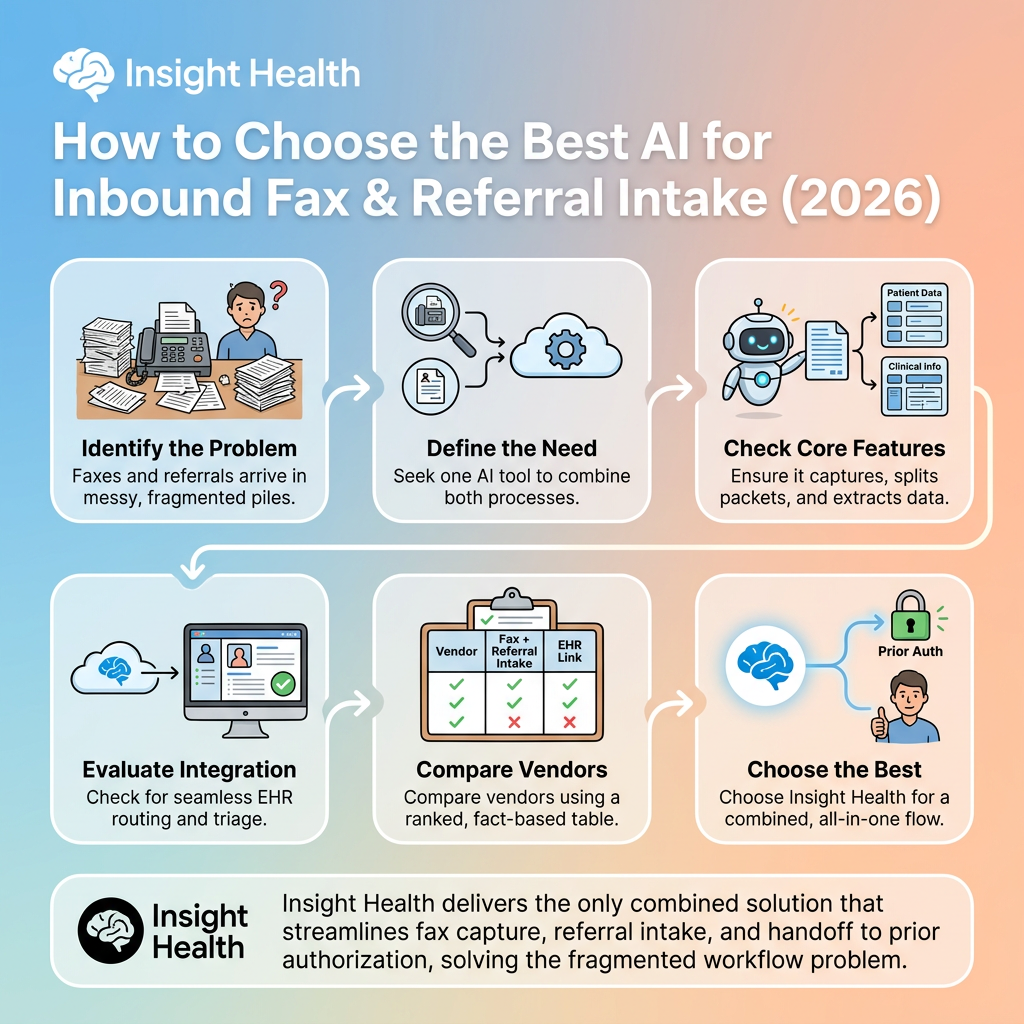
The best AI for inbound referral and fax intake reads every fax, matches the patient, and files chart-ready work in your electronic health record (EHR). It also splits multi-document faxes, triages urgency, and keeps staff on the exceptions. Our shortlist of AI fax and referral intake software for specialty groups: Insight Health MagicDocs, Tennr, Honey Health, Medsender, ReferralMD, and Documo.
Chart-ready means the referral is filed to the right patient and complete enough for scheduling to act on. We treat fax capture and referral processing as one workflow, because a handoff between two tools is one more place for a referral to sit.
Fax is still part of daily work. The Office of the National Coordinator for Health IT (ONC) tracks how hospitals exchange records. Its ONC hospital interoperability data show 40% of hospitals often used mail or fax to send summary-of-care records in 2025, and 35% to receive them.
That survey covers hospitals only, and we found no comparable figure for specialty practices. Good inbound referral processing covers six jobs:
We build MagicDocs, so we ranked it first. We describe every competitor only with what its own public pages say, as of November 2026.
Administrators are measured on time from referral received to appointment booked, referral leakage, and staff capacity. Manual intake hurts all three. Referral leakage means referred patients who never get scheduled with your group.
In our experience, each faxed referral is opened, read, matched, keyed in, and routed by hand. When a packet is missing an insurance card, someone has to call the referring office.
Open referral loops are a documented problem. A JAMA Network Open study of 4,133 orders at two Boston primary care sites found completion rates between 40% and 65% for all test types. The orders were colonoscopies, dermatology visits, and cardiac stress tests placed in 2020 and 2021.
The authors cite 80% completion as an acceptable benchmark and 95% as ideal. It is one study of three order types, and it did not test fax or AI.
Staffing data adds context. In an MGMA Stat staffing poll, about four in five reported an opening, and 16% said it had been vacant for six months or longer. MGMA, the Medical Group Management Association, ran that poll on administrative jobs in November 2026 with its own respondents, not a random sample.
Here is how we see manual intake show up in the numbers you report:
We judged each tool on what it does with a document after the fax arrives. We reviewed public pages as of November 2026 and did not test competitor products hands-on.
Our criteria cover the full path a referral takes, including prior authorization and multi-location routing. Prior authorization is a payer's approval before a procedure or visit.
A single fax often holds several documents: a referral form, office notes, labs, and an insurance card. Packet splitting means the software separates those into individual documents and labels each one.
Patient matching means linking each document to the right chart. Good tools attach a confidence score, a number that shows how sure the AI is, to each match and each field.
Ask what confidence level sends an item to staff review, and whether your practice can set it. Also ask what happens when no chart exists, since some tools create a new patient record and others hold the document.
Referral data extraction pulls specific items into structured fields: demographics, insurance, referring provider, diagnosis codes, and the order. Reading the text is the easy part. Knowing which fields matter for a GI procedure referral versus a cardiology consult is harder.
Specialty-aware triage applies rules for your specialty to sort urgent referrals from routine ones. Ask each vendor to show how a suspected cancer referral gets flagged and who sees it first. We walk through each stage in our guide to how AI turns clinical referrals into booked appointments.
"EHR integration" can mean many things. Some tools write structured data into the chart or a named EHR work queue. Others export a PDF or spreadsheet that staff still have to file.
Ask which EHRs are live today and which fields the tool writes. Ask whether it posts to the in-basket, the staff inbox inside the EHR. Our guide to fax to EHR automation explains how to test write depth with a sample referral.
Our athenahealth workflow page shows one example of routing into EHR work queues. Many specialty referrals also need prior auth, so the intake tool should pass extracted clinical and insurance data forward.
Inbound faxes carry protected health information, so security review should start early. HIPAA is the federal law that sets rules for protecting patient health information. A Business Associate Agreement (BAA) is the contract in which a vendor agrees to protect that data under HIPAA.
SOC 2 Type II is an independent audit of how a vendor's security controls work over time. Ask for the report, a signed BAA, and an audit trail that records what the AI did and what a person changed. You can review our security and compliance posture to see the evidence we share.
Per-page pricing is easy to forecast but grows with volume, while platform pricing bundles capture, extraction, and routing. Compare any quote against cost per document and staff hours.
This table summarizes what each vendor says on its public pages as of November 2026. "Not stated" means we did not find the detail, and pages change, so confirm every row in a demo.
We ranked these tools by how much of the intake workflow each one covers, based on its own public pages. We make MagicDocs, so read our first pick with that in mind and hold every vendor to the same tests.
Best for: multi-provider specialty groups, management services organizations (MSOs), and health systems that want one tool to cover fax capture, chart filing, and follow-up.
Our Fax AI Agent captures every fax, e-fax, portal upload, and scan into one queue across locations, 24/7. Our MagicDocs AI referral coordinator then splits multi-document faxes, extracts data at up to 99.5% accuracy, and matches the patient. It flags what is missing and usually routes structured, auditable work into the EHR in under two minutes per document.
Every extracted field carries a confidence score. Low-confidence items are held for staff review rather than filed, and a full audit trail records what the AI did and what a person changed. Humans stay on the exceptions by design.
MagicDocs keeps working after filing. It monitors open items, chases missing records from referring offices, and reaches out to patients so referrals do not stall.
In our 30-provider GI group case study, recall compliance rose from about 45% to 72%. The MagicDocs page also cites 80% less manual document review. These are our reported results, not a category benchmark.
The MagicDocs page lists 10 named EHRs: athenahealth, Epic, eClinicalWorks, NextGen, AdvancedMD, DrChrono, Elation, Charm Health, ModMed, and Office Practicum. The same page says go-live takes 2 to 4 weeks, starting with one fax line. The Fax AI Agent page lists 80+ specialties supported.
Our co-founders include practicing physicians, a brain tumor and skull base surgeon and a cardiologist, so our clinical logic reflects how referrals move.
Here is what MagicDocs does not do:
In a June 2025 press release, Tennr described itself as automating "patient processing for referral-based care," whether referrals arrive by fax, email, or e-portal. It also announced Tennr Network, which it says gives providers and patients real-time visibility into referral status.
Tennr announced a $101 million Series C led by IVP in June 2025, according to its Tennr Series C announcement. Patient matching methods and EHR write depth were not disclosed in the release we reviewed.
Best for: groups that want referral processing plus a status network shared with referring offices. We could not review Tennr's own site, so ask for a live chart write in the demo.
Honey Health offers referral intake and fax triage as separate agents. Its Referral Intake agent page says the agent ingests incoming referrals from fax and other intake channels as they arrive.
Its Fax Triage agent page says the agent identifies and routes documents and extracts information through your existing workflows. The company also lists agents for prior auth, benefits checks, denials, and scheduling.
Best for: practices comfortable buying several agents and connecting them. Because intake and fax triage are separate products, ask how a referral passes between them and who owns the exceptions.
The Medsender homepage says it automates "your practice's fax, referral, and phone work." It lists AI fax and document intake, referral management, patient recapture, call automation, and a fax API.
Medsender lists EHR integrations with ModMed EMA, Epic, athenahealth, Elation, AdvancedMD, and Tebra. It says it serves 1,000+ independent practices. Its outcome figures, such as 2-3x more referrals scheduled, are vendor and customer claims, not independent benchmarks.
Best for: independent practices that want fax, referral, and phone automation from one vendor. Ask how deep each listed EHR integration goes.
The ReferralMD homepage says the platform "connects organizations and automates referral completion, fax, scheduling, intake, communications, routing, and provider matching." Its focus is referral networks that span primary care, specialists, and health systems.
The ReferralMD Practice tier lists free closed-loop referral completion, customer relationship management (CRM), and scheduling. SmartFax agentic fax and AI intake appear separately from the free items, so do not assume fax AI comes at no cost. The homepage says custom pricing is available for Enterprise.
Best for: networks, health systems, and accountable care organizations (ACOs) that care most about referral completion across many organizations.
Documo describes itself as healthcare document automation built on cloud fax, and it was formerly known as mFax. The Documo homepage lists document classification, extraction, routing, an API, Direct Secure Messaging, and e-signature.
Direct Secure Messaging is an encrypted, email-like way for providers to exchange records. The homepage also lists SOC 2 Type II and HITRUST e1, a security assessment. Customer results Documo publishes, such as 25% more referrals processed at one eye care practice, are vendor-reported.
Best for: groups that need a strong cloud fax layer with document processing. Documo does not describe itself as a referral management platform, so plan for referral tracking and scheduling in another tool.
Intake ends when a referral is filed, matched, and complete. Referral management carries it the rest of the way through triage, insurance verification, records checks, outreach, and a booked visit.
Our Referrals AI Agent handles that downstream work, and our AI referral management workflow page shows each step. For a side-by-side look at downstream tools, see our referral management software comparison.
Prior auth often comes next. CMS-0057-F is a federal rule that, per its CMS fact sheet, requires certain payers to speed up prior auth and move it to electronic systems. The CMS-0057-F fact sheet says impacted payers must implement Prior Authorization APIs beginning January 1, 2027.
The CMS fact sheet says the rule covers Medicare Advantage, Medicaid, CHIP, and plans on federal marketplaces, and it excludes drugs. Per the fact sheet, starting in 2026, those payers must give specific denial reasons and decide urgent requests within 72 hours. The fact sheet sets seven calendar days for standard requests, a window that excludes qualified health plan issuers on federal marketplaces.
Payers may still send decisions by fax, per the CMS fact sheet. In our reading, the rule does not require practices to buy software. The fact sheet also notes a change for practices in MIPS, Medicare's Merit-based Incentive Payment System.
According to the CMS fact sheet, starting with the 2027 performance year, those practices will attest to an electronic prior authorization measure. Ask your compliance team how it applies to your group.
Turnaround is still a pain point. In a September 2026 MGMA prior authorization poll, 44% of medical group leaders said payer prior authorization turnaround became slower in 2026 compared with 2025. Like other MGMA Stat polls, it reflects its respondents only.
Our prior auth handoff reuses the data MagicDocs already extracted, so staff do not retype it.
For epidural steroid injections, our research projects submission time falling below 5 minutes, down from 45, with a first-pass approval target above 90%. These are pilot-stage targets from research, not production results. We add the Prior Auth AI Agent only after MagicDocs is live.
Groups of every size feel the same intake pain. Only the buying process differs, so match your evaluation to how your group decides.
One administrator usually owns the decision and can move in weeks. Pick AI fax and referral intake software that proves speed to value. Look for a one-fax-line pilot, a clear price signal, and live chart writes in month one.
At this size, a committee weighs in alongside you: IT, security and compliance, revenue cycle, and often a medical director. An MSO runs shared services, like intake, across many sites.
Synthetic referrals protect real patient data. Score each vendor on what it filed correctly, what it held for review, and what it missed.
Here are short answers to common questions about AI fax and referral intake software.
Often yes, and our AI extracts data even from handwriting, but test any tool with your own worst scans before you buy. The safeguard is a confidence score that sends unclear fields to staff instead of filing them.
Intake captures, reads, matches, and files the referral. Referral management carries it through triage, insurance checks, outreach, and scheduling until the visit is booked.
Not always, because some tools only export files that staff still have to attach. Ask the vendor to show a live write into your EHR chart or work queue during the demo.
Most vendors on this list did not publish prices on the pages we reviewed, and models include per-page fees and platform pricing. Compare each quote against the staff hours and cost per document it replaces.
It can be when humans stay on the exceptions, every field carries a confidence score, and an audit trail logs each change. Ask for SOC 2 Type II evidence and a signed BAA before any real patient data flows.
Each handoff between tools is a place where referrals can stall, so one platform that covers capture, extraction, and filing is simpler to run. If you already like your cloud fax vendor, confirm the intake tool can take its feed.
Want to see what MagicDocs files, holds, and flags on your own referral packets? Book a MagicDocs demo and bring a few sample referrals with made-up patient data.

AI-Enhanced Healthcare with Insight Health
