Healthcare Fax Automation in 2026: Key Statistics and Trends
Healthcare fax automation in 2026: statistics and trends


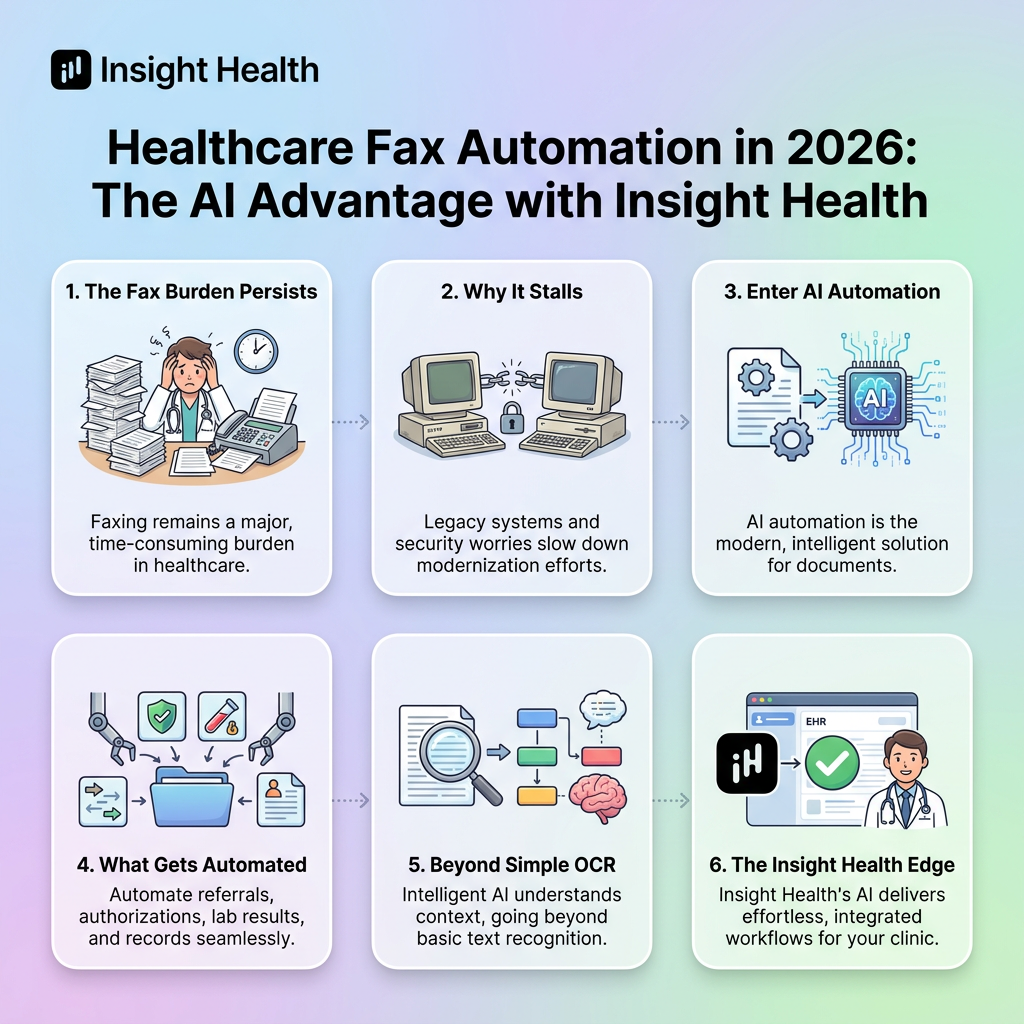
In 2026, fax still carries a large share of clinical document exchange. Healthcare fax automation is moving from digital inboxes to AI that reads, sorts, and routes each document. In 2025, 40% of hospitals often send and 35% often receive summary of care records by mail or fax, per ONC hospital exchange methods data.
The question is no longer how faxes arrive. It is who reads, matches, and files each one once it lands, and how long that takes.
We wrote this report for administrators at specialty groups, MSOs, and health systems who need sourced numbers for a CFO or board. We update it every year, and the methodology and sources section at the end lists each sample size and scope note.
The table below collects the figures administrators ask us about most, each with its source, year, and sample. Several come from our MGMA phone and fax report, a Spring 2026 survey of 300+ practice leaders that we published with MGMA.
Key statistics
Read the hospital and practice figures separately. ONC data cover hospitals only, and EHR/PM means the electronic health record and practice management systems a practice runs on.
The cloud numbers describe health systems, not practices. In the Sage Growth cloud fax survey, 65% of executives expect to fully transition to cloud faxing within two years. Cloud fax changes where a fax lands, but someone still has to read it.
MGMA notes that fax stays relevant because it moves information between organizations that still do not share data smoothly, especially across referral networks and payer workflows. In practice, we often see a referring office and a specialty group on different EHRs with only the fax line between them.
The hospital trend does not show a clean decline. In ONC data, the share of hospitals that often send these records by mail or fax went from 30% in 2023 to 40% in 2025.
ONC also reports a "sometimes" answer. Counting both answers, 74% of hospitals send and 81% receive these records by mail or fax at least sometimes. That is our own arithmetic on the 2025 figures.
Practices show the same pattern. In the MGMA Stat digital fax poll, nearly 1 practice in 4 (24%) lacked digital fax fully integrated with EHR/PM and workflows, while 73% do. Insight Health AI sponsored that poll (292 responses, March 17, 2026), so we disclose it here and in our methodology notes.
MGMA's poll found 73% of practices integrated, which sounds like healthcare fax automation is nearly done. In our more detailed Spring 2026 survey, 64% of practice leaders said their fax is not integrated with their EHR or PM system.
We read the gap as a definition problem. A yes-or-no question lets a digital inbox count as integration, while a detailed question asks what happens after the fax arrives.
Digital fax swaps a machine for an inbox. Someone still opens each document, decides what it is, finds the patient, and files it in the right chart.
The gap is widest in surgical and procedural practices, where 80% of leaders in our survey said fax is not integrated. We see this as a readiness problem. These groups need complete referrals, records, and payer paperwork before a procedure gets booked.
Healthcare fax automation lives in the right-hand column. True fax to EHR automation writes structured data into the chart instead of dropping a PDF into a folder.
In our Spring 2026 survey, we asked 300+ practice leaders, unprompted, what they would automate first. Scheduling led narrowly, with referral intake and fax sorting close behind.
For healthcare fax automation planning, burden data tell a sharper story than wish lists. Referrals ranked in the top three burdens for 73% of leaders, and prior auth and payer documentation ranked there for 75%.
Scheduling often starts as a phone problem, but it ends in documents. A booked visit still needs a complete referral and a chart-ready record.
Referrals are the clearest test of whether fax is truly integrated. Each one must be matched to a patient, checked for missing records, routed to the right provider, and tracked until a visit is booked.
Every referral that stalls in a fax queue risks referral leakage, where the patient books elsewhere or not at all. An AI referral management workflow tracks each referral from arrival to booked appointment. That gives administrators a clean measure of time from referral received to appointment booked.
Prior auth is the other heavy document workload. On average, practices complete 40 prior auths per physician, per week, according to the AMA 2025 prior authorization survey.
Physicians and their staff spend 13 hours each week completing them, based on that December 2025 survey of 1,000 physicians. Physicians also named the phone as their most common method for medical services, so fax is one channel among several.
Staffing absorbs much of that load. In the same AMA survey, 40% of physicians said they have staff who work exclusively on prior auth.
An earlier MGMA regulatory burden report finding showed 92% of surveyed medical group practices hired or reassigned staff solely to handle growing prior auth volume. MGMA does not state that survey's year, so treat it as historical context.
Labs, imaging reports, and records requests fill out the rest of the inbound stack. They often arrive as multi-page packets that staff must split, label, and file one document at a time.
Outbound requests add churn. When a referring office or payer asks for records, staff pull, assemble, and fax them back, then field follow-up calls when pages go missing.
We found no national dataset that measures this work for practices. That is why your own fax audit, covered below, matters more than any benchmark.
Optical character recognition (OCR) is software that turns an image of text into searchable text. It makes a fax readable, but it cannot tell an urgent referral from a routine lab result.
AI document processing is where fax automation in healthcare goes further. It identifies each document, extracts the fields that matter, matches the patient, and flags what is missing.
AI is also moving into daily practice operations. In the MGMA 2025 AI adoption poll, nearly 7 in 10 (68%) medical groups reported adding or expanding use of AI tools in 2025. That poll (351 responses) covers AI of all kinds, led by clinical documentation and scheduling, not fax specifically.
Our MagicDocs AI referral coordinator reads each inbound document and extracts data at up to 99.5% accuracy. It matches the patient and routes structured work into the EHR in under two minutes.
The Insight Health Fax AI Agent owns the fax line itself. It captures every fax, e-fax, portal upload, and scanned record into one work queue across locations.
Humans stay on the exceptions by design. Here is how that works in practice:
At one of our customers, a 30-provider gastroenterology group, administrators cut manual document review by 80% and saved $250,000 a year. They also moved four staff members to higher-value work and cleared a year-long referral and colonoscopy recall backlog.
Group size changes the buying process. In our experience, a 10 to 50 provider group usually has one administrator focused on speed to value. At 50 to 100+ providers, MSOs and health systems bring a committee that asks about security, audit trails, multi-location routing, and integration depth.
HIPAA is the federal law that sets rules for protecting patient health information. SOC 2 Type II is an independent audit of how well a company's security controls work over time. We meet both standards and integrate with 11+ EHRs, including Epic, athenahealth, eClinicalWorks, NextGen, and ModMed.
We also build with practicing physicians. Our co-founders include Dr. Pankaj Gore, a brain and skull base surgeon, and Dr. Eric Stecker, a cardiologist at Oregon Health and Science University.
The 2025 CAQH Index report states that an additional $21 billion in potential savings remains within reach through further automation. It puts the average medical provider cost at $8.03 per manual transaction and $2.65 per electronic one.
Those figures average across all transaction types. They are a benchmark for manual versus electronic handling, not the cost of a single fax or prior auth.
CAQH also reports that 40% of medical plan prior authorization transactions were fully electronic in the 2025 Index, up from 31% in the 2023 Index. For your own business case, multiply monthly fax volume by staff minutes per document and your loaded hourly cost.
CMS-0057-F is a federal rule that requires certain payers to make prior authorization faster and support it electronically. It applies to impacted payers: Medicare Advantage organizations, Medicaid and CHIP programs, and qualified health plan issuers on the federal exchanges.
The rule does not cover employer or other commercial plans, and it excludes drugs. Most impacted payers must decide urgent requests within 72 hours and standard requests within seven calendar days, generally beginning January 1, 2026.
The API deadline comes next. The CMS-0057-F fact sheet says the Prior Authorization API requirement must be implemented beginning January 1, 2027.
An API is a connection that lets two software systems exchange data directly. This one runs on FHIR (Fast Healthcare Interoperability Resources), a standard format for sharing health data between systems.
The rule does not retire fax. Payers must give a specific denial reason no matter how they send it, fax included. Practices should plan to handle electronic and faxed prior auth side by side.
Our platform is built for CMS-0057-F, with readiness for FHIR PAS, the FHIR standard for submitting prior auth requests and receiving decisions. For dates by payer type, see our CMS-0057-F explainer, and confirm specifics with your compliance team.
Four trends shape healthcare fax automation after 2026. Each one points to the same shift, from moving faxes to acting on them.
Before you buy any healthcare fax automation, run a one-week fax audit. Our guide to automate medical fax processing walks through each step.
These are the questions administrators ask us most about healthcare fax automation in 2026. Each answer draws on the sources above.
Yes. In 2025, 40% of US hospitals often sent and 35% often received summary of care records by mail or fax, according to ONC data.
Digital fax moves faxes from a machine to an inbox, while staff still sort, match, and file each one. AI fax automation reads each document, matches the patient, flags gaps, and routes structured data into the EHR, with humans on the exceptions.
Yes for routine documents: MagicDocs extracts data at up to 99.5% accuracy and routes work into the EHR in under two minutes. Low-confidence items are held for staff review instead of being filed.
In our Spring 2026 survey with MGMA, 75% of leaders ranked prior auth and payer documentation in their top three burdens, and 73% ranked referrals.
No. Impacted payers must support a Prior Authorization API beginning January 1, 2027. The rule does not prohibit fax, so practices should plan to handle both.
We compiled this healthcare fax automation report in November 2026 from primary sources, each read in full. We list sample sizes and scope limits so you can quote each figure accurately.
We will refresh these figures in our next annual update. To see what this looks like on your own fax line, see how MagicDocs handles your fax and referral queue.

AI-Enhanced Healthcare with Insight Health
