How to Automate Procedure Prior Authorization in 6 Steps
How to automate procedure prior authorization in your clinic


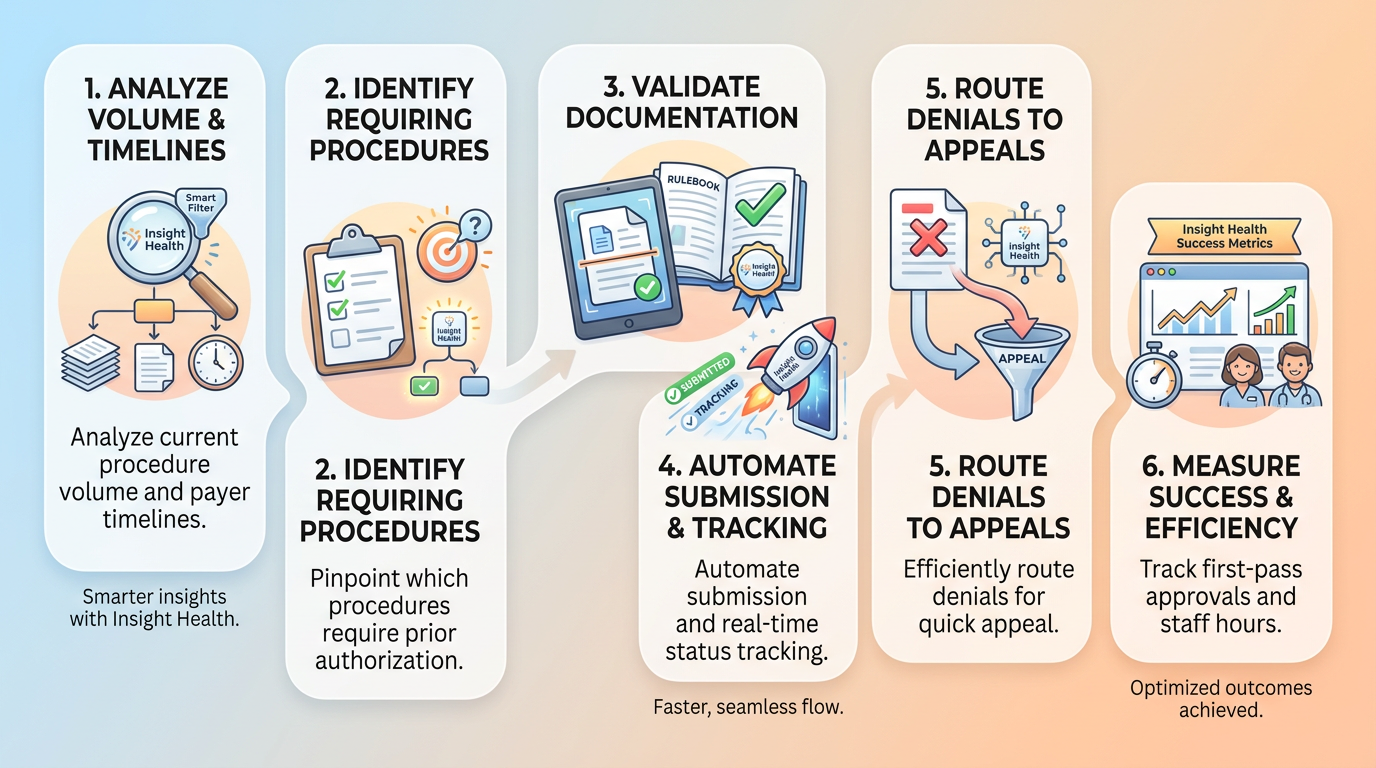
Prior authorization is the approval a payer must give before your clinic performs a procedure. This guide shows how to automate procedure prior authorization in six steps for specialty groups of 10 to 100+ providers, MSOs, and health system clinics.
Yes. AI can automate the administrative side of prior auth: checking whether a procedure needs approval, gathering records, submitting, tracking status, and routing denials. Clinicians still own medical necessity decisions and peer-to-peer reviews, which are live calls with a payer's physician reviewer.
The workload is heavy. In the 2025 AMA prior authorization survey, 1,000 surveyed physicians reported completing an average of 40 prior authorizations per week. They also reported that prior auth takes an average of 13 hours of physician and staff time each week.
We treat prior auth as an extension of the referral and document pipeline. MagicDocs, our AI referral coordinator, reads the referral packet once, and the Prior Auth AI Agent builds the request from that same packet. Humans stay on the exceptions by design, and an audit trail records every action.
Insight Health is physician-founded. Our co-chief medical officers are a neurosurgeon and a cardiologist, so our logic reflects how procedure orders move through a real clinic.
Size the rollout to your group. At 10 to 50 providers, one administrator can usually own it end to end. At 50 to 100+ providers, an MSO, or a health system, bring IT, security, compliance, and revenue cycle in at Step 1.
Measure what you have before you automate anything. Pull 90 days of procedure prior auth requests from your EHR (electronic health record) and practice management system. Sort them by CPT code (the billing code for the procedure), payer, and site.
Then capture the time stamps behind days to authorization, the number your CFO will ask about. Days to authorization is the calendar time from a signed order to the payer's decision. Split it in two so you can see whether the delay sits inside your clinic or with the payer.
If your system cannot report staff touches, pull a sample of requests and count by hand. A small, documented sample still gives you a baseline you can defend.
Rank procedures by three factors: volume, denial rate, and delay. A procedure that scores high on all three has the most room to improve. Start with 3 to 5 procedures and your top payers by volume.
Next, map who reviews each request. Some health plans hand procedure reviews to third-party utilization management (UM) vendors. Each vendor has its own portal and criteria, so your rules need to know which vendor handles which plan and CPT code.
Traditional Medicare is changing too. Under the WISeR (Wasteful and Inappropriate Service Reduction) model, CMS is testing technology-assisted prior auth for a select set of services, such as skin and tissue substitutes, electrical nerve stimulator implants, and knee arthroscopy for knee osteoarthritis. It covers traditional Medicare only, not Medicare Advantage.
The CMS WISeR model page states the model runs for six performance years, January 1, 2026, through December 31, 2031. The six states are Arizona, New Jersey, Ohio, Oklahoma, Texas, and Washington. If you have sites there, read our guide to the Medicare WISeR model.
A request is only as strong as the records behind it. The goal of this step is to confirm a request is complete before it goes out. That way, your team finds the gaps instead of the payer.
Payer criteria are the clinical rules a payer uses to decide whether a procedure is medically necessary. They differ by payer, by UM vendor, and by CPT code.
Use this checklist for every procedure request. MagicDocs uses AI document processing to pull these fields from the referral packet. It extracts data at up to 99.5% accuracy in under 2 minutes per document.
The agent also checks ICD-10 codes against the CPT code and the clinical notes. That catches coding errors before they become denials.
Criteria change by specialty, and our logic is specialty-aware across 80+ specialties. An epidural steroid injection (ESI), a spine injection for nerve pain, needs a different record set than a knee replacement. Our orthopedic prior authorization workflow shows one example.
A readiness score measures how complete a request is against the payer's criteria. Each request gets a score before submission, and the score sets its path. These branches are our pilot-stage design, not a deployed result.
Every extracted field carries a confidence score. Low-confidence items are held for staff review instead of filed.
For ESIs, our research projects submission time dropping from 45 minutes to under 5 minutes per request. This is a pilot-stage projection from research, not a deployed result.
Prior auth still moves through four channels: APIs, payer portals, fax, and phone. An API (application programming interface) lets two systems share data directly, so no one retypes it. Your automation has to cover all four.
The 2025 CAQH Index reports medical plan adoption of fully electronic prior auth at 40% in 2025, up from 31% in 2023. That figure is plan-reported, and it means portal, fax, and phone coverage still matter.
Our Prior Auth AI Agent submits through payer portals with no manual data entry. It then tracks status across API, portal, fax, and phone. When a payer asks for more information, the request returns to the gap-fill branch.
CMS-0057-F is a CMS rule that requires certain payers to speed up and digitize prior auth. Starting in 2026, the CMS-0057-F final rule requires impacted payers to decide within 72 hours for expedited requests and seven calendar days for standard requests. These timeframes do not apply to drugs or to qualified health plan issuers on the federally facilitated exchanges.
Impacted payers must also generally have a Prior Authorization API in place by January 1, 2027. FHIR (Fast Healthcare Interoperability Resources) is the data standard behind these APIs. FHIR PAS is the HL7 guide for sending prior auth requests and getting decisions through them.
That API deadline binds payers, not your practice. Practices do get one new item: a MIPS electronic prior authorization attestation measure starting with the CY2027 performance period. Confirm the details with your compliance team.
We built the platform for CMS-0057-F with FHIR PAS readiness ahead of the January 2027 payer mandate. Our CMS-0057-F explainer covers the rule in more depth.
A denial starts a new workflow. Automation should classify the denial reason, route it to the right owner, and assemble the records an appeal needs.
Peer-to-peer reviews stay with clinicians. Automation can prepare the records, but the clinician makes the clinical case.
Appeals are often worth filing. In Medicare Advantage, only 11.5% of denied prior auth requests were appealed in 2024, according to the KFF Medicare Advantage analysis. That same year, 80.7% of Medicare Advantage appeals were partially or fully overturned.
Assembling records automatically lowers the effort of filing each appeal. Our prior auth appeals guide walks through the full process.
First-pass approval rate is the share of requests approved on the first submission, with no resubmission or appeal. Compare each metric below to your Step 1 baseline at 30, 60, and 90 days.
Our research sets a first-pass approval target above 90%, against the 70% to 80% industry average used in that research. This is a pilot-stage projection from research, not a deployed result.
For outside context, the KFF 2025 insurer metrics use insurer-posted data on standard requests. Medicare Advantage insurers denied 12%, Medicaid managed care insurers denied 14%, and ACA Marketplace insurers denied 18%.
These 2025 figures come from a different dataset than the 2024 Medicare Advantage figures in Step 5. Do not compare them directly. For more benchmarks, see our 2026 approval rate data.
These five mistakes slow down most rollouts we plan. Each one is easy to avoid with planning.
This is why we start with MagicDocs. In one 30-provider gastroenterology group, MagicDocs cut manual document review by 80%, a document workflow result rather than a prior auth figure.
These are short answers to questions administrators raise when planning a rollout. Each one maps back to a step above.
Measure your baseline, start with 3 to 5 high-volume procedures, and check documents against payer criteria before submission. Then automate submission, tracking, and denial routing, and measure first-pass approval against your baseline.
Yes, AI can handle the administrative work of checking need, gathering records, submitting, tracking, and routing denials. Clinicians keep medical necessity decisions and peer-to-peer reviews.
No, the Prior Authorization API deadline, generally January 1, 2027, applies to impacted payers rather than practices. Practices should plan for the MIPS electronic prior authorization attestation measure starting with the CY2027 performance period.
Timing depends on your EHR, payer mix, and how many procedures you start with, so we scope it during planning. Starting with MagicDocs live and 3 to 5 procedures keeps the first phase small.
No, staff shift from data entry to exceptions, gap-fills, and appeals, while clinicians keep every clinical decision. Humans stay on the exceptions by design.
Prior auth runs on the same documents your team already handles for referrals. We start with MagicDocs, then add the Prior Auth AI Agent once documents flow cleanly. The platform integrates with 11+ EHRs, including Epic, athenahealth, eClinicalWorks, NextGen, and ModMed.
For enterprise review, we meet HIPAA, the federal law that protects patient health information. We also meet SOC 2 Type II, an independent audit that tests security controls over time.
Prior auth status checks and missing-record requests also reach your front office by phone. A phone audit shows that call volume and how it connects to your document workflow. Get a Free Procedure Audit.

AI-Enhanced Healthcare with Insight Health
